
Four-strand DNA structures are nowadays one of the most interesting objects in research. The most popular of them is G-quadruplex (G4-DNA) formed by oligonucleotides rich in guanines. This structures are stabilized by a Hoogsteen's hydrogen bonds between guanines and also by a cation which is located in the channel between the guanine tetrads. There are exist few type of G-quadruplex topology: parallel, antiparallel and hybrid which formation depends on the direction of the DNA strands. [1,2]
The planar G-quartet is able to interact with other planar structures such as porphyrin molecule of hemin. It is proven that this complex is able to catalyze peroxidation reaction. The guanine's oxygen atoms interact with iron atom, located in a hemin molecule (cofactor of this DNAzyme). The increase of strength of this type of interaction affects also the peroxidase activity of this complex. Enzymes formed by nucleic acids are more stable in high temperature than protein enzymes which results in determination of a broader range of analytes. Other advantage of this system is facilitating the development of a new analytical strategies based on the phenomenon of hybridization between complementary DNA strands. [2,3]
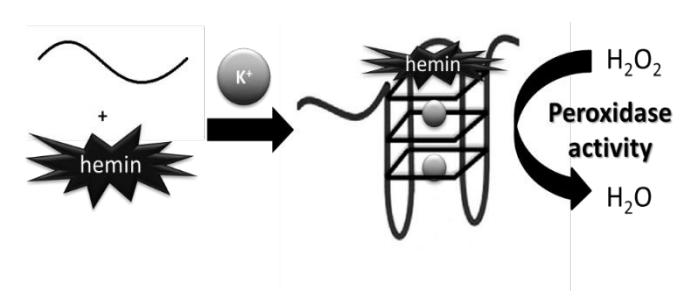
Appropriate modification of DNAzyme allows on the improvement of the analytical signal produced during peroxidase reaction. This is possible through the covalent attachment of hemin, which allows to reduce the analytical signal from reference probe (hemin activity) and to avoid addition of surfactant. The second approach is the covalent attachment of the functionalized quantum dots to DNAzyme. This approach allows to apply the unique photochemical properties of quantum dots like high fluorescence. This modification enables also the generation of reactive forms of oxygen on the surface on quantum dots and allows to avoid the addition of hydrogen peroxide to the reaction medium. In our research we used amino modified oligonucleotides and NHS-active hemin ester in the reaction of amine coupling to create DNA-hemin covalent conjugate. We also used quantum dots functionalized by 3-mercaptopropionic acid to create a DNA-QD system. [3,4] This compounds were characterized spectroscopically. And in the next step we measured the most important feature of DNAzymes, the peroxidase activity. Our research prove that modified DNAzyme are a better alternative to horseradish peroxidase commonly used in ELISA or Western blot tests.