
Cobalt and its alloys are widely used, e.g. as superalloys, anticorrosion and wear-protecting coatings, magnetic recording devices and medical equipment. However the depletion of fossil fuels and growing rate of global warming are increasing the need for eco-friendly and efficient energy sources, such as O2 and H2 fuel cells. Currently obtaining pure H2 gas is very expensive. Metallic foams, that have high surface area, could be used as efficient and cheap catalyst for oxygen evolution reaction (OER) and hydrogen evolution reaction (HER). The aim of this work was to design a simple and cheap procedure to manufacture Co foams by means of electrodeposition, using hydrogen bubbles as dynamic template.
Co metallic foams were deposited under galvanostatic conditions at high current densities (0.6-2.5 A/cm2) onto copper substrate from acidic solution (pH 2) containing 0.2 M CoCl2 and 2 M NH4Cl. Obtained Co foams were characterized by Scanning Electron Microscope (SEM) and Energy Dispersive Spectroscopy (EDS) and Electrochemical Impedance spectroscopy (EIS). Cylindrical pores were clearly visible on the coatings, however the density of the pores was rather low and neither pores diameter nor their density was dependent on the current density applied. In order to increase the porosity of Co coatings, solution surface tension was reduced by adding 2 M isopropanol. The increase of diameter of pores, overall porosity as well as surface area was observed, however the addition of 2M isopropanol has significantly reduced the current. Even though obtained Co-foam coatings after synthesis were blown dry with hot air stream, according to EDS data they contain up to 50 at.% of oxygen and 3 at. % of chlorine. The surface area of cobalt foams was estimated from capacitance of double electric layer (CDES) obtained from EIS data.
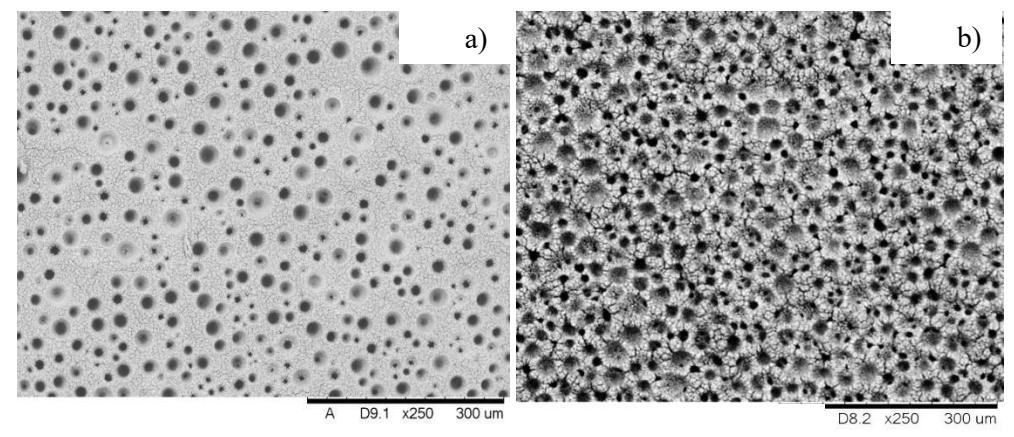
In the interest of increasing the surface area of Co-foams, the effect of angle between working electrode and counter electrode during galvanostatic electrodeposition also was investigated. The working electrode was situated in parallel, at 45° and 90° angles in regard to counter electrode. Samples obtained at 45° angle contained more pores on both sides. Porosity of Co-foams obtained at 90° angle has also increased, but only on the side facing the bottom of the electrochemical cell. Catalytic activity of Co foams for hydrogen evolution reaction was tested in 0.1 M KOH solution by voltammetry. HER started at the potential region of -0.75-0.85 V. Some peaks which might be attributed to the partial reduction of cobalt compounds have been observed at -0.3 V (CoO and Co(OH)2) and at -0.7 V (CoOOH and Co3O4).