
In recent years technologies have advanced enormously. This has enabled chemists to perform various types of chemical reactions that were not possible before. The remaining challenge for the material scientists is not only the synthesis and investigation of new compounds, but also a comparison of different molecular systems and establishment of the general trends, relation of the structural modifications of chemical compounds to the different properties. For example, connecting electron donor (D) with acceptor (A) via para linkage leads to direct conjugation, the highest oscillator strength, delocalization of frontier orbitals through the molecule, etc. While it is known that meta- linkage is responsible for the decreased conjugation strength, as well as reduced photoluminescence quantum yield (PL QY), it localizes the frontier orbitals more on donor and acceptor. Moreover, usage of meta linking can lead to more rigid structure. Other important structural modification is the introduction of $\pi$-spacer within the D-A system. By physically prolonging the distance between D and A it is possible to achieve higher localization of frontier orbitals on D and A and still to maintain high oscillator strength. Thus, by varying the linkage between the donor, spacer and acceptor it is possible to tune the most of desired properties in the resulting compound.
In our work we mainly focus on the organic semiconductors, dedicated to the field of organic light emitting diodes (OLEDs). More precisely, bipolar donor-acceptor type compounds meant to be used in the emissive layers (EML) in OLEDs. Usage of bipolar molecular architecture is one of the leading approaches to design multifunctional compounds with large variety of desired properties: appropriate singlet and triplet energy levels, high PL QY in solid state, appropriate ionization potential and electron affinity energy levels (depending whether we design emitter/host or exciplex-forming compound), thermal, electrochemical stability, etc.
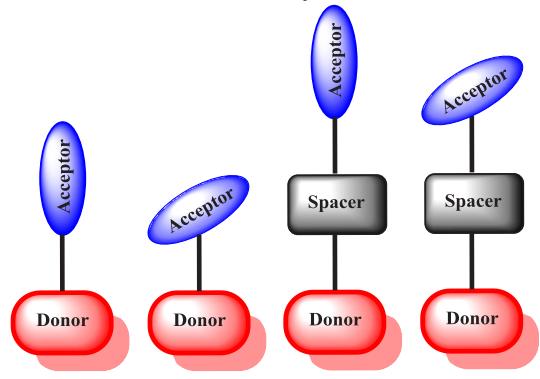
Our aim of this work was to design, synthesize and characterize new bipolar organic semiconductors, based on carbazole (D) and benzonitrile (A). In this presentation we will show how the introduction of spacer, change of linkage between D and A moieties (Fig. 1.) influence the thermal, electrochemical, optical and photophysical properties of these bipolar compounds. In addition, the results of quantum chemistry calculations will be discussed for the better insight on the structure-property relationship.