
Discovery of organic conductive polymers stimulated development of thin-layer, flexible electronic devices. For many years organic light emitting diodes (OLED) and organic photovoltaics (OPV) cells have been widely investigated because of unique properties which can be comparable with their non-organic semiconductor analogues. Simple fabrication and cheap depositing methods allowing to increase easily a range of production surpass disadvantages coming from typically lower efficiency of organic devices.
Nanotechnology is emerging field of natural sciences and it allows to improve parameters of many old-fashioned systems. Smaller crystallines allow not only to use less material, make devices smaller and, because of it, cheaper, but also often lead to better material parameters. Photoluminescence quantum efficiency of several zero-dimensional systems (so-called quantum dots (QD)) can surpass 50% [1]. Using them in hybrid QD-OLEDs can increase electroluminescence dozens times, for example ITO/TPD/QD/Alq3/Mg:Ag QD-OLED structure surpasses luminescence efficiency of other similar devices 25 times [2]
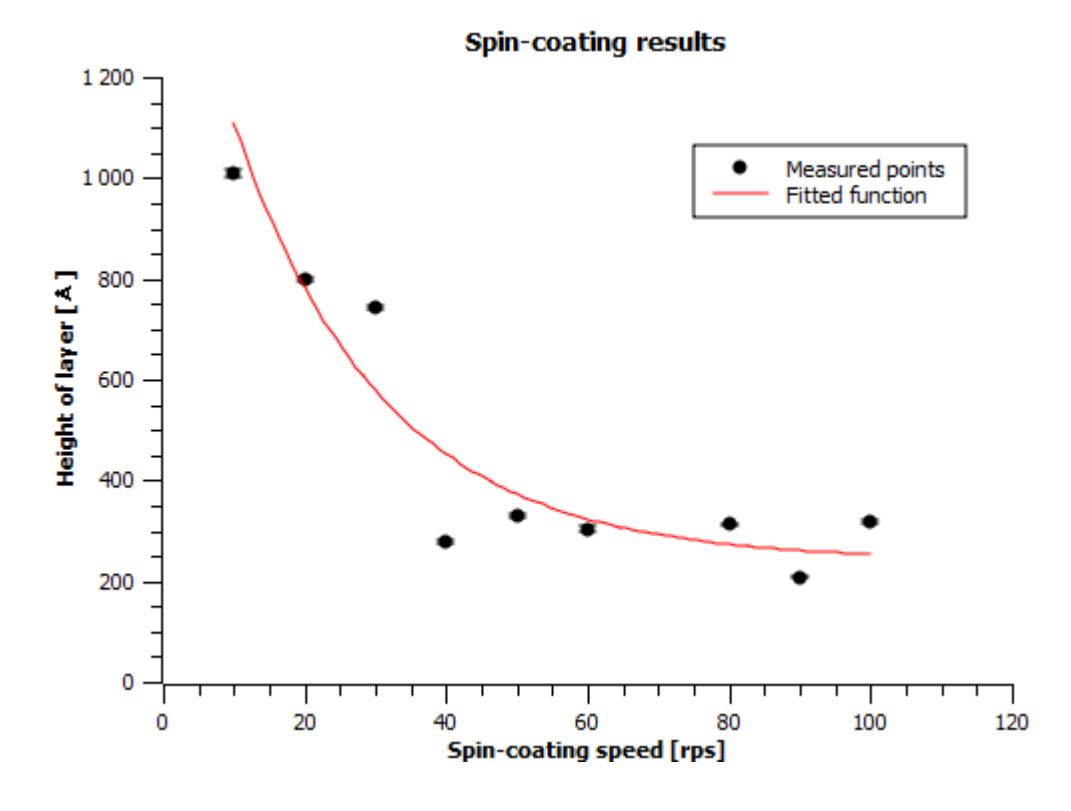
Ease of controlling layer thickness by changing spin-coating speed (example of layer thickness control shown in Fig. 1) allows for a precise change of several parameters of a whole device. Solutions and liquid substances used in the spin-coating technique enable the smooth deposit of a single layer or even multilayer. Therefore, only a few fast and easy steps are required to achieve complexity of devices.
In this paper we present results of our initial work performed in aim to obtain cheap, efficient and flexible light source, based on QDs and organic thin layers. To construct QD-OLED with the following structure: ITO/PEDOT:PSS/CdSeQD/C60/Al, we used spin coating deposition. Such prepared device was tested for luminescence efficiency and I-V characteristics. Similar system without QDs was also prepared by the same technique and used as a reference sample.