
Cyclodextrins (CDs) are macrocyclic oligosaccharides that combine a hydrophobic nanosized cavity with a hydrophilic surface [1]. The cavity enables the partial or total incorporation of lipophilic molecules by host-guest inclusion mechanism and formation and supramolecular water-soluble structures. Such structures may be used in various areas: pharmacology, molecular electronics, production of sensors, nanoscale chips, etc. Porphyrin—cyclodextrin complexes are supposed to be used for the purposes of photodynamic therapy. Generally, the formation of inclusion complexes enhance the solubility of the photosensitizer (PS) molecules and protect PS from aggregation.
The porphyrin used in the study is 5,10,15,20-tetra(m-hydroxyphenyl)chlorin (mTHPC). It is one of the most potent second-generation clinically approved photosensitizer [2]. The main limitation of its application in PDT is a low water-solubility. To prevent mTHPC aggregation several special formulations, such as liposomes, polymer solutions and bioconjugates were designed. An application of specialized pharmacological formulations supposes a development of new experimental techniques to control photosensitizer distribution in biological media. Cyclic oligosaccharides, cyclodextrins, are also considered as perspective formulation for tetrapyrrolic photosensitizers [3]. This study is aimed on the investigation of complexation mechanisms between mTHPC and β-CD derivatives: methyl-β-cyclodextrin (Me-β-CD) and trimethyl-β-cyclodextrin (TM-β-CD).
It has been shown, that the addition of β-CDs in aqueous solution of mTHPC results in the formation of stable inclusion complexes (Fig. 1) and monomerization of mTHPC. It results to the restoration spectral-fluorescence properties of mTHPC, including increase of fluorescence quantum yield compared to ethanolic solution.
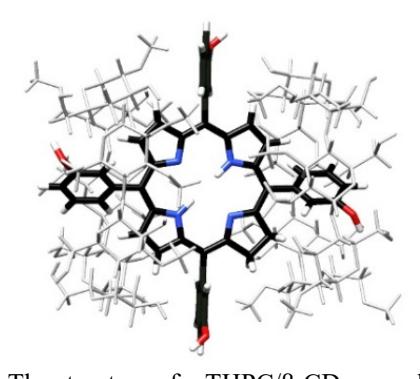
The kinetic and equilibrium processes of complexation between mTHPC and β-CDs were studied. It was demonstrated, that TM-β-CD possessed higher affinity to mTHPC as compared to Me-β-CD. The numerical values of mTHPC/m-β-CD association constants were determined from titration curves of mTHPC by β-CDs obtained by means of spectrofluorimetry and circular dichroism techniques. The estimation of association constants was performed by mathematical modeling with different complexation models. It was found, that value of apparent association constant is depends on concentration of mTHPC owing to PS aggregation. Moreover, the inclusion complexes may be realized with the both mTHPC: β-CD stoichiometry 1:2 and 1:1.