
Magnetosensitive nanocomposites with different surface types are the most promising materials produced for various branches of industry. These materials, taking into account their effectiveness and economic feasibility, are still used for solving numerous urgent problems like removing, separating and concentrating toxic compounds from natural and synthetic liquids, including the technogenic liquids. The nano-sized single-domain magnetite possesses an important place among other perspective materials used in creation of nanocomposites [1-3].
In this work, nano-sized single-domain magnetite was synthesized, its surface chemical modification was carried out, and adsorption properties of $Fe_3O_4$, $Fe_3O_4/TiO_2$ nanostructures were researched regarding $Y^{3+}$ ions. Magnetite was synthesized according to the reaction: $Fe^{2+} + 2Fe^{3+} + 8NH_4OH \rightarrow Fe_3O_4 + 4H_2O + 8NH_4^{+}$. Magnetite particles with fraction size of 10-30 nm corresponding to single-domain state with optimum magnetic properties and specific surface area $S = 105 \text{ m}^2/\text{g}$ were used. To modify nanoparticles we used n-butylorthotitanates. The composites were obtained from samples of magnetite by adsorption modification (AM). So, we received the layered structure. Obtained composites were investigated by IR spectroscopy, DTGA, defined surface area.
Research in adsorption properties of Fe3O4, Fe3O4/TiO2 (AM) nanocomposites with respect to Y3+ cations was carried out dynamically at pH = 6.5 and room temperature using standard solutions with 0.5 to 40 mg/l (m = 0.03g, V = 5 ml) concentrations. The composites were investigated IR spectroscopy (Fig.1, 2). To research into pH influence, acetate buffer ($C_0$ Y3+ = 25 mg/l) was used.
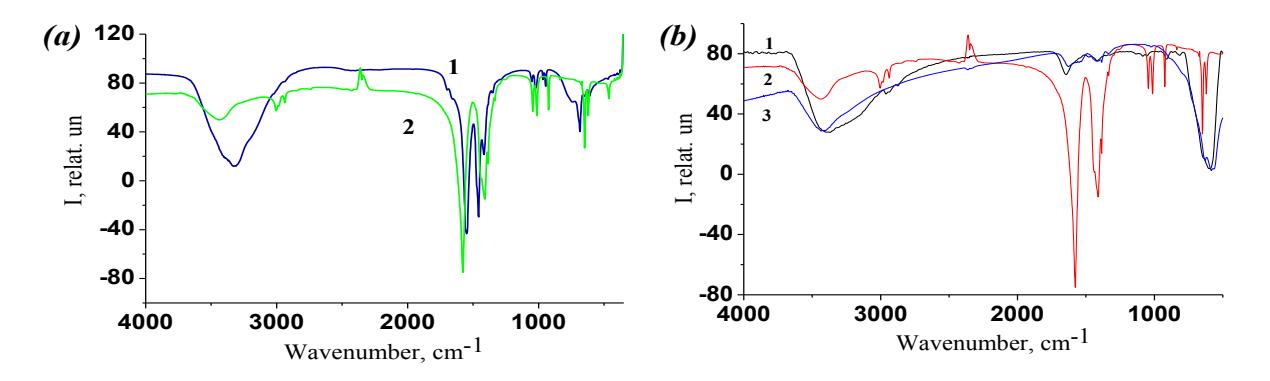
Adsorption capacity on the surface of original and modified magnetite was determined by dynamic measuring of $Y^{3+}$ concentration in solution with spectrophotometric method ($\lambda=645$ nm). Adsorption capacity of magnetite after its surface modification with TiO2 increases. Adsorption saturation is reached after 15-30 minutes for all the nanocomposites. The increase in $Y^{3+}$ equilibrium concentration leads to adsorption saturation. The best $Y^{3+}$ removal characteristics correspond to $Fe_3O_4/TiO_2$ (AM) surface. The calculated values of sorption capacity A mg/g ($Fe_3O_4/TiO_2$ - 7.23 mg/g), and extraction extent R% - 96%.