Nowadays there is a large variety of scintillation materials which find apply as detectors of photons and high-energy particles in areas such as high energy physics, nuclear physics, medicine, national security, exploration and so on. Despite the sufficient variety of both the scintillation materials and areas of their application there is a list of characteristics that the ideal scintillator should possess. These characteristics include: high density of scintillator and atomic numbers of the elements used, a high light yield and energy resolution, short decay time, no afterglow, low cost, high radiation and mechanical resistance, absence of self-radioactivity [1, 2]. At present time the scintillation material which could simultaneously combine all the above mentioned properties does not exist. Among the scintillation materials halide compounds in comparison with oxide holds the record in energy resolution and light output. Due to the relatively low cost and availability halides of alkaline earth elements are sufficiently attractive for mass use, in particular BaI2, which has high $Z_{\rm ef}$, is not radioactive and has the smallest band gap among the alkaline earth metals halides. In accordance with the foregoing, the synthesis methods development and study of the synthesis conditions effect on the properties of the obtained BaI2 is of practical interest.
BaI2:Eu2+,Eu3+ powder has been obtained by heat treatment in iodinating agent atmosphere of precursor BaCO3:Eu3+ obtained by coprecipitation [3]. The use of the two-step approach to the synthesis of BaI2:Eu2+,Eu3+ opens up opportunities for the control of its structural, morphological, and as a result, luminescent properties, both due to the modification of the precursor and varying its heat treatment parameters.
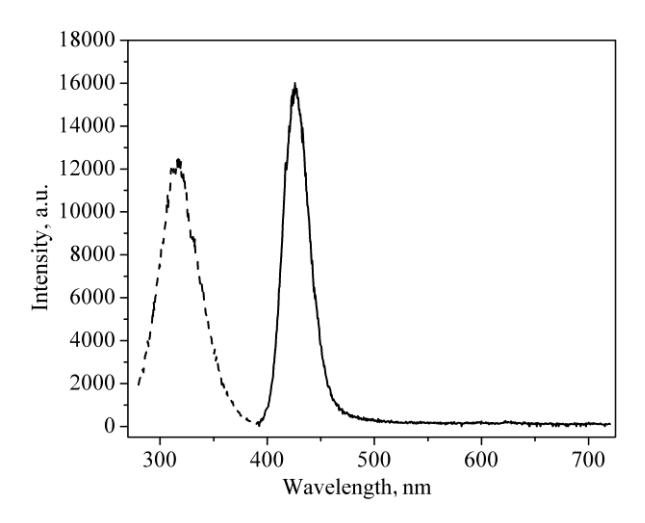
Synthesis conditions (inert atmosphere, synthesis temperature 400°C, duration – 30 minutes), allowing to obtain BaI2:Eu2+,Eu3+ powders containing no impurity phases have been found. It was discovered that obtained powder is a mixture of crystalline hydrates of different composition with a predominance of BaI2·2H2O. It is shown that in BaI2:Eu2+,Eu3+ powders synthesis a transition Eu3+ → Eu2+ occurs, which completeness is defined both by the BaI2:Eu2+,Eu3+ synthesis conditions (the reactants ratio, the ion-activator concentration, atmosphere, synthesis temperature and its duration) and morphology characteristics of the precursor particles. The possibility of controlling the Eu2+ ions luminescence band displacement in BaI2:Eu2+,Eu3+ powders by codoping powders with cations of alkaline-earth elements has been demonstrated.
Thus, in present work the optimal conditions of BaI2:Eu2+,Eu3+ powders formation have been determined and the synthesis conditions effect on their morphological, structural and luminescent properties has been studied.