Giant internodal cells of freshwater algae Characeae for many decades have provided an excellent experimental system expanding the knowledge in plant electrophysiology as well as offering some evolutionary insights. Experiments on Characeaen algae have significantly contributed to better understanding of the properties of plant signaling via analyzing action potentials as well as the characteristics of ion channels [1].
Patch clamp technique employs a microelectrode to seal an area of a chosen membrane to create a high resistance (usually larger than 1 G$\Omega$) contact. Thus any electrical current passing through the sealed area can be easily detected in high resolution – activity of a single ion channel can be recorded. Since its development patch clamp technique has been an irreplaceable method for investigating ion channels in near physiological conditions in plants [2].
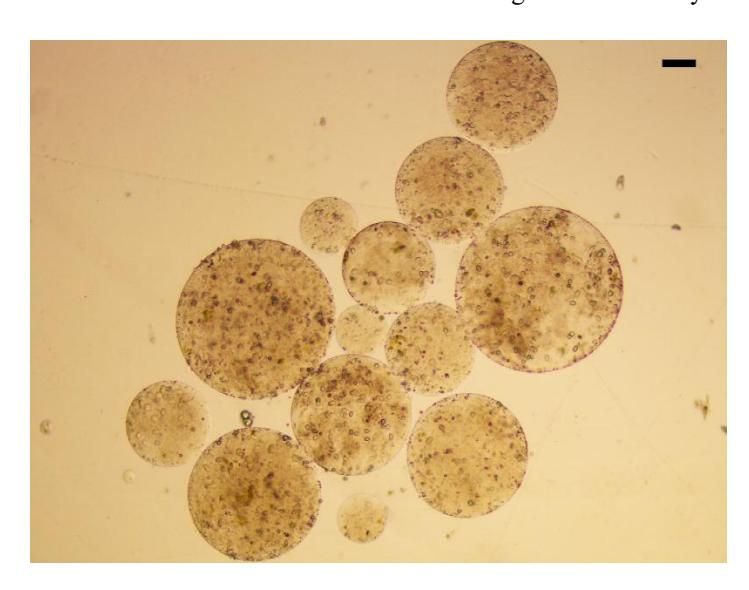
The cell wall of the Characeaen algae stands as an obstacle as it is very difficult to reach the plasma membrane without damaging it in order to observe the activity of ion channels. The cytoplasmic droplet (Fig. 1) technique overcomes this issue by taking advantage of the vacuolar membrane, the tonoplast. If a Characeaen cell is placed in a tube filled with a solution, approximately isotonic with the cell sap, and “decapitated”, the cytoplasm may flow out of the cell to a drop of solution spontaneously forming cytoplasmic droplets [3]. The droplets consist of cytoplasm covered with the tonoplast and in the solution assume a spherical shape. The composition of ion channels in the tonoplast is not particularly diverse - K+ and Cl- channels of various conductivity have been previously described [4].
Glutamate is a neurochemical widely utilized in animal kingdom for signaling. Even though glutamate has some significance in the plant metabolism, its possible role as a signaling molecule in plants has not been investigated on a single channel level in Characeaen cells. The effect of another neurotransmitter acetylcholine has been already studied in Chara corallina tonoplast [5].
In our present experiments we attempted to adapt our equipment to suit the needs of making cytoplasmic droplets from Characeaen Nitellopsis obtusa and recording data via the patch clamp technique. Experimental conditions enabled us to record the activity of functional ion channels in the tonoplast.
Our goal is to characterize the found channels and determine whether glutamate has any effect on them.