
Nitrogen-vacancy (NV) centres are powerful instruments in many areas of research, such as magnetometry, quantum information, nanoscale sensing. They have been used to detect individual electron spins and spin ensembles, measure the magnetic field distributions in biological signals, measure temperature and electric fields [1].
NV centres are defects in diamond crystal consisting of paired nitrogen (N) and vacancy (V) with two electrons in it. The NV centre has a triplet ground state with a zero-field splitting between the ms = 0 and ms = ±1 ground state sublevels of 2.87 GHz. The NV centre can be optically polarized due to nonradiative decay path from the excited state via singlet state that preferentially populates the ms = 0 ground-state sublevel. This is the reason why the fluorescence from exciting ms = 0 sublevel is more intense than the fluorescence from exciting the ms = ±1 sublevels. In presence of microwave field population of ms = 0 can be transferred to m = ±1 levels, decreasing the total detected fluorescence. The quanzation axis is defined by the NV centre axis direction. If the magnetic field is applied along this axis, the ms = ±1 energies are shifted by $g_e \mu_B B_z$ or 2.8 MHz/G. At around 1025 G a crossing of ground state sublevels ms = 0 and ms = −1 appear and due to nuclear spin interaction of 14N, the hyperfine states of ms = 0 and ms = −1 (states $|0,0\rangle$, $|-1,1\rangle$ and states $|0,-1\rangle$, $|-1,0\rangle$) are mixed and anticrossing is formed, creating complex energy level system (Fig. 1).
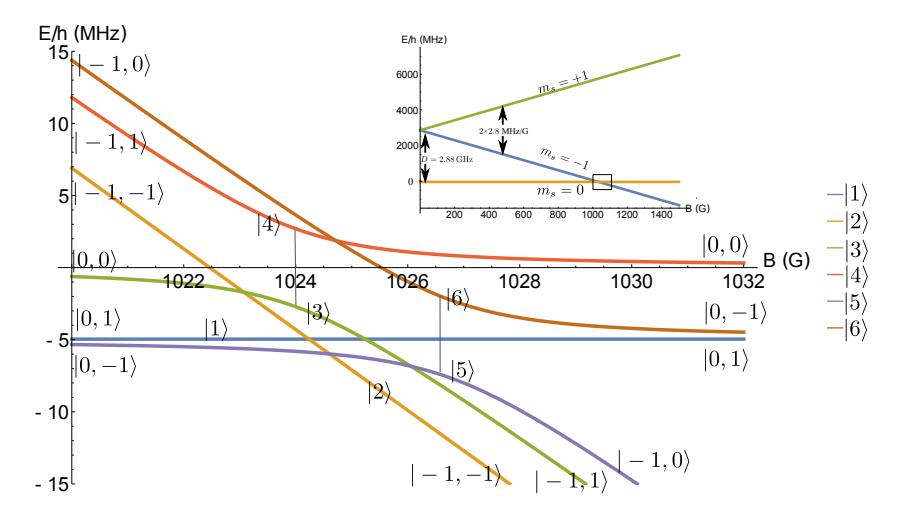
At the point of the anticrossing the wave functions of the ground state ms = 0 and ms = -1 hyperfine sublevels are mixed, modifying the probabilities for magnetic-dipole transition of microwave field.
System Hamiltonian of NV centre ground state including interaction of nuclear spin, magnetic field at the range of level crossing, is calculated as [2]
$$\hat{H} = g_e \mu_B \mathbf{B} \hat{\mathbf{S}} + \hat{\mathbf{S}} \hat{D} \hat{\mathbf{S}} + \hat{H}_{HFI}, \tag{1}$$where $g_e \mu_B \mathbf{B}\hat{\mathbf{S}}$ describes interaction with magnetic field, $\hat{\mathbf{S}}\hat{D}\hat{\mathbf{S}}$ - describes spin - spin interaction of two unpaired electrons of NV centre and $\hat{H}_{HFI}$ - describes the hyperfine interaction of 14N (IN = 1).
To simulate microwave interaction spin step-up and step-down operators for magnetic-dipole transitions are used.