
As a new focus on materials research and a novel alloy design concept, high entropy alloys (HEAs) have been achieved successfully and have attracted great attentions of material researchers since it was proposed in 2004 [1,2]. HEAs exhibit promising future for engineering applications due to their good thermal stability, high hardness and high strength, excellent wear resistance, as well as many other outstanding properties [3,4]. Most of multi-component high entropy alloys were designed as equi-atomic or near equi-atomic and were mainly prepared by vacuum arc melting.
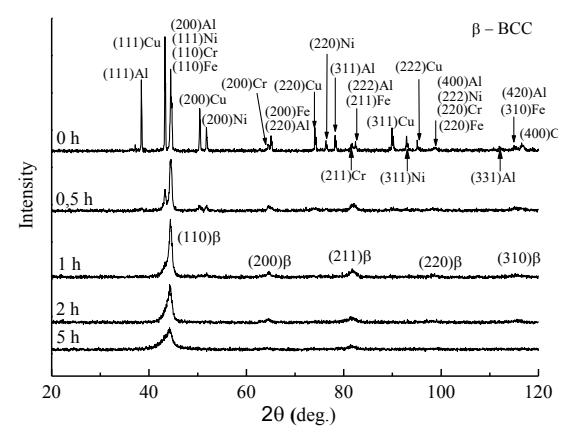
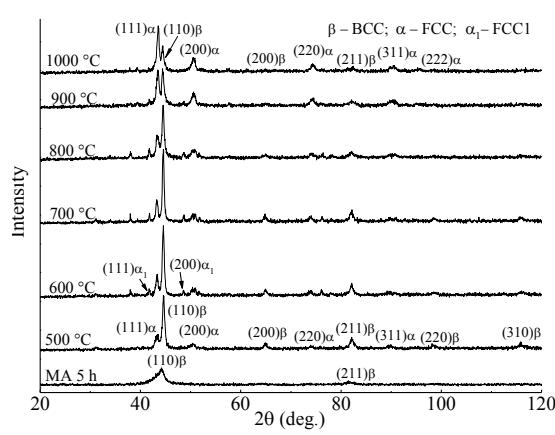
This study reports the structural evolution of equiatomic AlCuNiFeCr high-entropy alloy from elemental materials to solid solution during mechanical alloying (MA), and further, to equilibrium phases during subsequent thermal annealing and sintering. The effects of milling duration and subsequent annealing at temperatures ranging from 500 to 1000 °C on the structure and phase transformation were investigated by means of Rigaku Ultima IV X-ray diffractometer (XRD) with Cu Kα radiation. A scanning electron microscope with an energy dispersive spectrometer (EDS) was used to observe microstructures and measure the composition of powder alloy. The thermal analysis in the temperature range of 50–1430 °C was carried out in a STA449F1 differential scanning calorimeter (DSC) at a heating rate of 20 K/min under flowing purified argon atmosphere. It was justified experimentally that MA of Al-Cu-Ni-Fe-Cr powder mixture during 5 hours resulted in a single-phase nanocrystalline HEA with a structure of BCC-solid solution (Fig. 1). BCC solid solutions appear when the blended powder is ball milled more than 1h. The 5h ball milled alloy powder shows excellent chemical homogeneity and refined morphology with mean particle size of less than 10 μm. The microscaled particles are actually hard agglomerations of nanoscaled crystallites with crystal size of about 20 nm. During thermal annealing recovery and recrystallization of the BCC solid solution take place at temperatures ranging from 120 to 550 °C, and precipitation of second phase with FCC structure and grain growth of equilibrium phases occur at higher temperatures (Fig. 2). The phase composition transforms to BCC and FCC solid solutions when the mechanically alloyed powder was annealed at 500 °C for 1h. After annealing at 600 °C, the XRD pattern exhibits small FCC1($\alpha_1$) peaks along with BCC and FCC peaks. The BCC and FCC solid solution structures can be maintained even after the alloy was annealed at 1000 °C. Simple equilibrium phases obtained in the annealed state of MA powders confirm that the high-entropy effect enhances the formation of simple solid solution phases instead of complex compound phases.
The 5h milled alloy powder was subsequently consolidated by sintering under pressure 5 GPa and SPS at 800 °C for 30 and 15 min, respectively. The alloy with a density of 99 % after sintering exhibits excellent mechanical properties. The yield stress, Young modulus, and Vickers hardness of the alloy after sintering under pressure are 3.05, 148 and 9.2 GPa, and those after SPS are 2.8, 143 and 8.5 GPa, respectively.