S100 family proteins are involved in different cell activities: proliferation, survival, movement, inflammatory signalling and reproduction [1]. Because of their wide range of functions, these proteins can be associated with many diseases, including cancer and neurodegenerative disorders. There are reports showing that S100A9 protein can aggregate into amyloid fibrils and is possibly involved in Alzheimers and Parkinsons diseases [2]. Similar to other members in S100 family, S100A9 stability can be regulated by calcium [3], however there is too little information on how calcium ions affect S100A9 protein stability and aggregation into amyloid-like structures. Therefore we decided to investigate these properties.
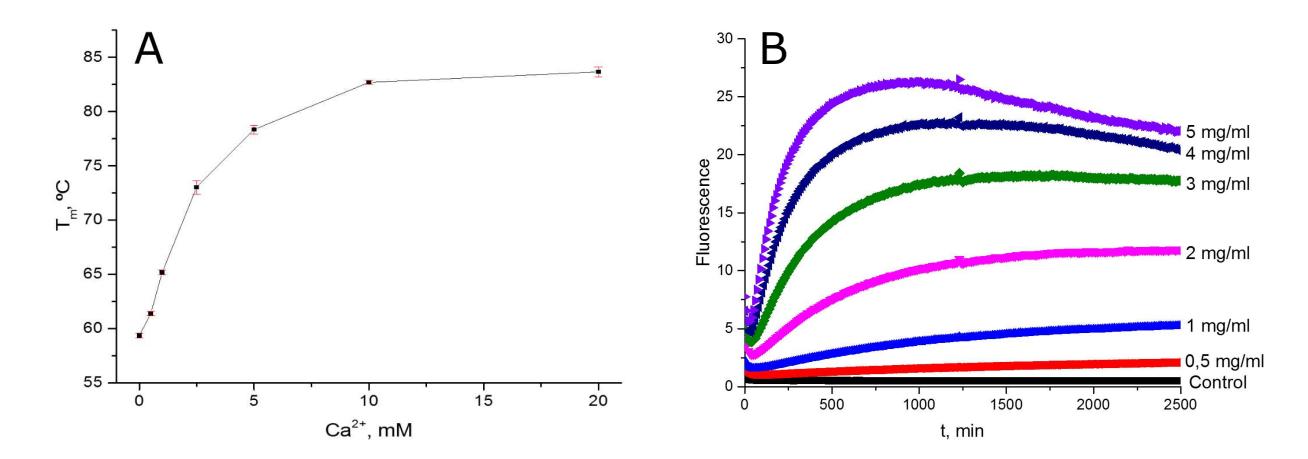
Thermal unfolding of the protein was monitored using ANS fluorescence assay. Calcium-protein binding events were studied using isothermal titration calorimetry (ITC). Aggregation kinetics of S100A9 were observed using Thioflavin-T (ThT) fluorescence assay (Fig.1). Formed amyloid-like fibrils were observed using atomic force microscopy and the nature of fibrils was confirmed using specific A11 and OC antibodies.
Our results show, that calcium exponentially increases protein thermal stability (Fig.1) and inhibits the rate of aggregation. ITC data suggests, that calcium binds to multiple sites and induces conformational changes of the protein structure, however more detailed research is needed to identify different protein states.