
The Carl Zeiss INTRABEAM® system is a mobile x-ray unit for intraoperative radiotherapy (IORT). It has been clinically used for over fifteen years, however, up to now, the treatment prescription proceeded considering the patient as a large volume of water, neglecting the tissue inhomogeneities or backscatter. RADIANCE (GMV, Spain) is the only available treatment planning system (TPS) platform that has been designed for IORT devices, including INTRABEAM®. The engine of this TPS is a modified hybrid Monte Carlo algorithm. It is not clear, whether doses calculated by this algorithm agree with real doses produced by INTRABEAM®. The aim of this work is to investigate the behavior of hybrid Monte Carlo algorithm and accept or reject the feasibility of using the INTRABEAM-RADIANCE system in the clinical field.
Measured dose distribution from radiochromic Gafchromic EBT3 films were used as a reference in comparison with simulated dose distributions from RADIANCE TPS. PTW solid water (RW-1), solid muscle (RM-1) and solid fat (RF-1) slabs were used to examine the behavior of Hybrid Monte Carlo algorithm in homogeneous, as well as inhomogeneous medium for 4 cm spherical INTRABEAM applicator (Fig. 1). Comparisons were based on gamma index evaluation, 10%-1mm local pass criteria was considered a good agreement between measured and calculated dose distributions.
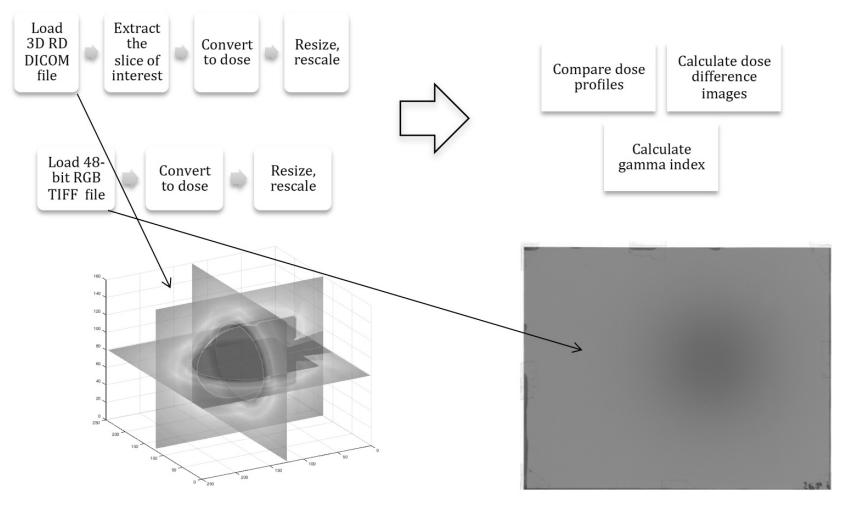
Absolute dose distributions from RADIANCE TPS and Gafchromic EBT3 film were compared. Dose distributions calculated with hybrid Monte Carlo algorithm showed good agreement with the dose distribution measured on film in solid water medium, for 4 cm spherical applicator gamma (10%-1mm) passed with 98.26% pixels, however, in inhomogeneous materials, gamma passing rate was 91.87% in solid muscle and only 66.93% in solid fat.
To conclude, the hybrid MC algorithm in RADIANCE TPS simulates dose distributions in water material with high accuracy, nevertheless, the impact of inhomogeneities in media lead to failure in producing the equitable dose distributions. Therefore, to use the RADIANCE TPS in the clinical field for predicting the dose distributions in intraoperative radiotherapy for INTRABEAM® would be improper.