
The quark model of hadron classification proposed by Murray Gell-Mann [1] and George Zweig [2] in 1964 motivated the opinion that a new state of matter, namely strongly interacting matter composed of subhadronic constituents, may exist. Soon thereafter, quantum chromodynamics (QCD) was formulated as the theory of strong interactions, with quarks and gluons as elementary constituents.
At low temperatures and baryonic chemical potentials (e.g. in the nuclei) quarks are always confined in hadrons. Increasing temperature and density of hadrons lets us unleash the elementary constituents of matter. The state that is formed is called the quark-gluon plasma (QGP)[3, 4, 5]. The characteristic of this phenomenon is often presented in form of the phase diagram of strongly interacting matter (Figure 1). It demonstrates the conditions which have to occur for the quark-gluon plasma to be created. Exact position of the critical point and the onset of deconfinement remain the subject of intensive experimental and theoretical studies.
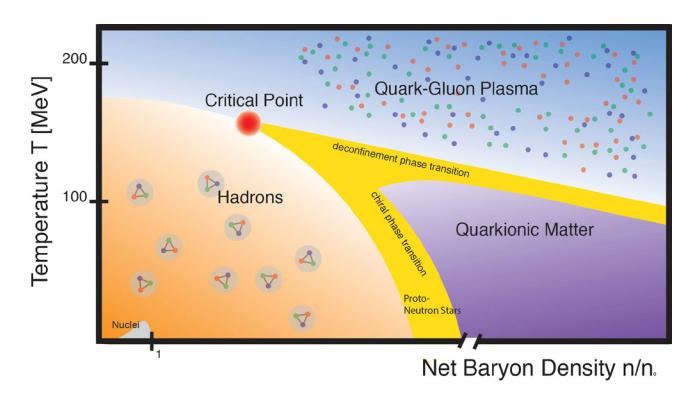
The quark-gluon plasma is a very mysterious and elusive state of matter. Probing signals of the existence of this deconfined phase is the main goal of the NA61/SHINE experiment at CERN. The task is performed by numerous measurements of particles produced in heavy-ion collisions. Three of the most distinct signals are: the kink, the dale and the step[6]. These mysterious names are related to shapes of different particle properties plotted against the collision energy.
In my talk I will describe one of the signals of deconfinement - the kink. This will be done with a description of the full process of heavy-ion collision data analysis in background. Based on the data obtained recently in the NA61/SHINE experiment I will follow through the whole path - from data acquisition to obtaining the final particle yields. In the end I will relate the results to the kink plot.