
Measuring the IR absorption spectrum of the protonated water dimer (PWD) in the gas phase has been challenging. Only in the late 80s of the last century the group of Lee has developed two methods of measuring the IR spectra of the PWD in the gas phase. The first method is based on use of a carrier gas such as hydrogen or some other inert gas [1]. The second technique involves infrared multiphoton dissociation (IRMPD) [2]. However, the IR spectral range used in this work was very narrow (3500-3800 cm-1). Later IR absorption spectra of the PWD in the gas phase were obtained in the spectral region of vibrations of the central proton (600-2000 cm-1) [3]. The authors of [4] carried out a number of experiments on measuring IR spectra of the PWD using the "carrier gas" method. This time, in addition to the experiments with Ar gas, similar studies were performed using Ne as carrier gas. The authors convincingly show that, due to the smaller perturbation in case of Ne, the IR spectrum is closer to the C2 configuration than in case of Ar, where the PWD presumably has the CS configuration. Recently, new experimental IR spectra investigations of the PWD with helium atom as the carrier [5] are found close enough, in terms of basic characteristics, to the IR spectra of the PWD+Ne. In particular, the doublet of bands around 1000 cm-1 is red-shifted by only 7 cm-1 (to 921 and 1040 cm-1). Taking into account the decrease of the perturbation effects caused by a helium atom compared to neon, the authors of [5] suggested that the PWD+He IR spectrum is practically equivalent to the free PWD IR spectrum.
Although one can see progress in experimental investigation of the PWD+X (X=Ar,Ne,He) [1,4,5], the only theoretical work [6], where structure and IR spectrum of the PWD+Ar complex were calculated, was published only recently. In order to understand this situation in more detail, harmonic and anharmonic calculations of IR spectra of H5+O2+Ar and H5+O2+Ne complexes were carried out in the PBEH1PBE/acc-pVTZ approximation. The optimized structures of these complexes are presented in Fig. 1.
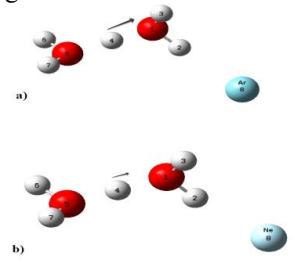
As indicated in Fig.1 and as can be seen from the results of the calculations, the proton tends to move towards the water molecule that is closer to Ar/Ne/He. In case of Ar atom, this shift is more significant. So we can assume that addition of the Ar/Ne/He atom to the PWD molecule stabilizes the H3O+ fragment of the PWD. Our calculations confirm the deformation of the C2 configuration, but for both complexes (H5+O2+Ar, H5+O2+Ne, H5+O2+He ) the water molecules are still oriented relative to each other similarly as in the case of the C2 configuration, i.e. only the proton shifts towards one of the monomers without relative rotation of the water molecules; the shift in the case of H5+O2+Ar is significantly bigger than in the case of H5+O2+Ne and H5+O2+He, but the O1O5 distance is in neither case hardly affected compared to the case without carrier gas. Harmonic and anharmonic spectra of the complexes will be discussed in details in a forthcoming report.