
Frequency stability is regarded as absence of frequency drift or maintaining a single fixed frequency as long as possible. Precision play an important role in high speed communications, navigation, frequency standards, spectroscopy and in numerous other important applications [1].
Using femtosecond optical combs the absolute frequency of light can be determined. We use Erbium fiber based optical frequency comb synthesizer that covers a broad optical spectrum 530...1000 nm emitting 150 fs pulses with 250 MHz repetition frequency.
Together with a 780 nm ECFL diode laser and a Rb vapor saturation set-up we are attempting to measure precisely the hyperfine splitting of Rb atoms. The laser is slowly scanned across all the Rubidium saturation peaks to calculate the optical frequency. During different measurements inconsistencies and slight shifting of absolute frequencies of the rubidium lines were observed due to variations of power of the diode laser. This happens as a result of AC Stark shift. This leads to further investigations to observe the frequency depending on the laser power (see Fig. 1).
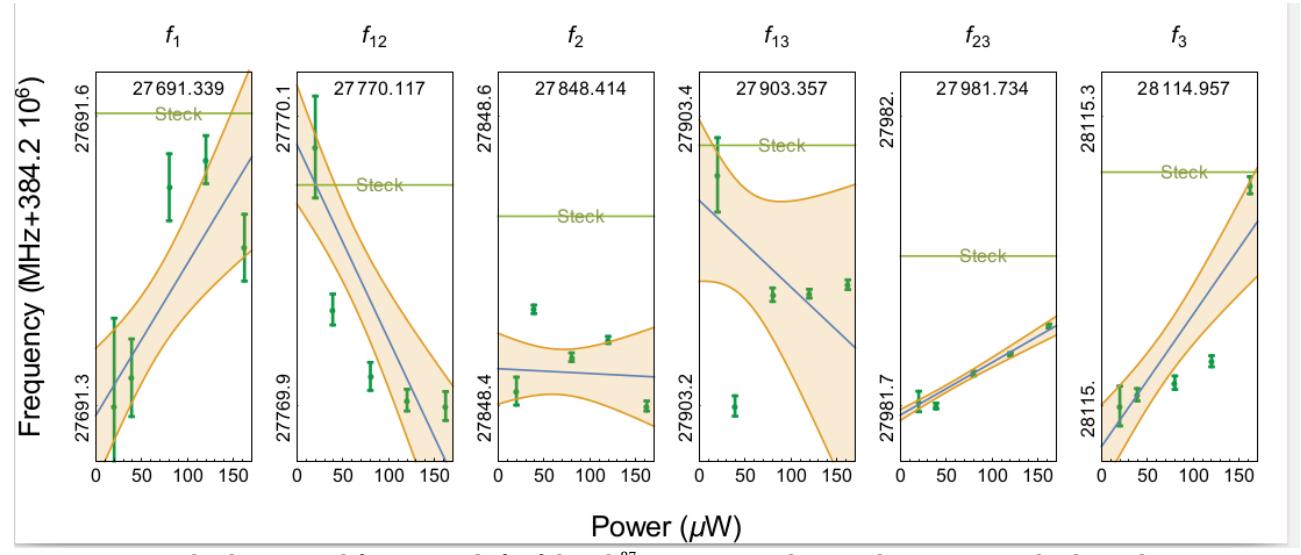
Hereafter we want to combine the frequency comb and Rb saturation spectroscopy with the Whispering Gallery Mode (WGM) resonator to compensate for thermal drift and improve the long-term stability. WGM resonators have a high Q factor and resonant frequencies are far apart from each other which provides resonant optical feedback to the laser. As a result the frequency noise and laser line width decreases and stability improves [2, 3]. Also the WGM resonators shaped like micro-spheres, a few hundred μm in diameter, can be easily made by melting the tip of an optical fiber.