
Hodgkin disease is a type of lymphoma. Lymphoma is a cancer of a part of the immune system called the lymph system. The first sign of Hodgkin disease is often an enlarged lymph node. Hodgkin lymphoma accounts for 5% to 6% of all childhood cancer. Hodgkin lymphoma is a potentially curable lymphoma. The World Health Organization classifies Hodgkin lymphoma into five gty: nodular sclerosing, mixed cellularity (see the image below), lymphocyte depleted, lymphocyte rich, and nodular lymphocyte-predominant. The 5-year overall survival for Hodgkin lymphoma of all stages is very high, usually greater than 80%. Patients with stage I or II disease have overall survival rates greater than 90%, whereas those with stage III or IV disease have overall survival rates as low as 70%.
Despite being one of the most common and well studied cancers, with both well documented diagnostic and treatment protocols, very little is know about epidemiological situation in Lithuania. Data for this study was collected in Vilnius university Santariškės Childrens hospital retrospectively, from case reports of pacients, treated from 2010 to 2015. Out of 27 histories, 8 met our criteria: children, diagnosed with Hodgkin's lymphoma (HL), currently juvenile, treated at Children's Hospital, affiliate of Vilnius University Hospital Santariškių klinikos.
27 patients were diagnosed with HL in 2010-2015. 13 boys, 14 girls. Twelve are currently adults. 1 was treated in Kaunas. 1 refused biopsy, due to that, diagnosis could not be confirmed. 1 refused chemotherapy. 1 deceased. 1 patient was excluded due to receiving bone marrow transplant. No data on 2 patients.
Eight patients fully met our criteria. 4 boys (50%) and 4 girls (50%). Median age of diagnosis was 10,25+-5,1. Youngest patient was 4 years old. 5 patients were (62.5%) in full remission. Main symptom was enlarged lymph nodes 35%.
Stage at diagnosis: stage II to IV (II stage – 5 (62%), III stage – 2 (25%) ir IV stage – 1 (13%)). HL nodular sclerosis type- 6 (75%), HL mixed cellularity type – 2 (25%).
Chemotherapy applied in accordance with EuroNet-PHL-C1 protocol (2006). 2 patients, stage IIIA ir IIIB received radiotherapy. Relapses 2 (40%) out of 5, both boys. Both relapsed patientss reached remission again. Radiological diagnostic procedures performed: 36 CT, 4 Ro, 17 PET. Out of all radiological scans, most common were: Chest 13 (36%), neck and chest CTs 10 (28%). In average, one patient received 4,5 CT scans. Highest number of CT scans received - 10. First CT for all of the patients was either chest or lung CT scan.
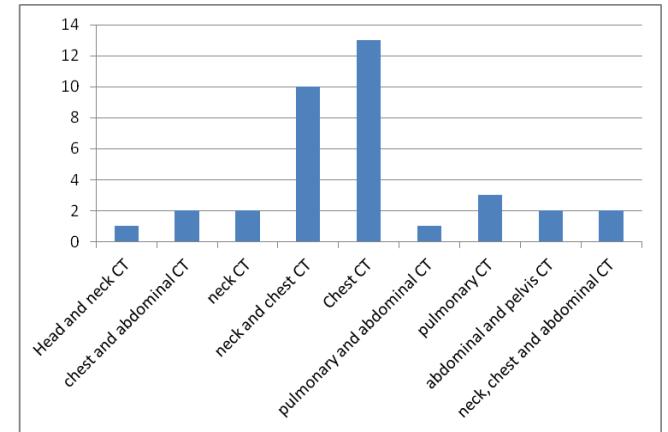
First symptom usually is lymphadenopathy for patients, diagnosed with HL. HL most commonly diagnosed at stage II, nodular sclerosis hystological type. Main method of diagnostics - CT scan.