
Non-small cell lung cancer (NSCLC) is one of the most common malignant tumors and the leading cause of all cancer related deaths worldwide. Aproximatelly 1.8 million people (1.240.600 men and 583.100 women) all over the world were newly diagnosed with lung cancer in 2012[2,3]. Epidemiological data in Lithuania reflects similar tendencies with 1421 new cases (8.0% of all cancers) and 1355 deaths (16.9%) in 2012[1].
Various studies showed that lung cancer is caused by both genetic and environmental factors and especially their interactions. Although exposure to carcinogens is considered to be the main cause, genetic variation and Human papillomavirus (HPV) may contribute to lung cancer risk. However, exact biomarkers for precise lung cancer prevention, diagnostics, treatment and prognosis still are under the investigations. Moreover, the functional polymorphisms in genes TP53 Arg72Pro (rs1042522), MDM2 T309G (rs2279744), MDM4 (rs4245739), MTHFR (rs1801133), CASP8 (rs3834129) and CCR5 (rs333) alone or in combination, can affect survival (Fig.1).
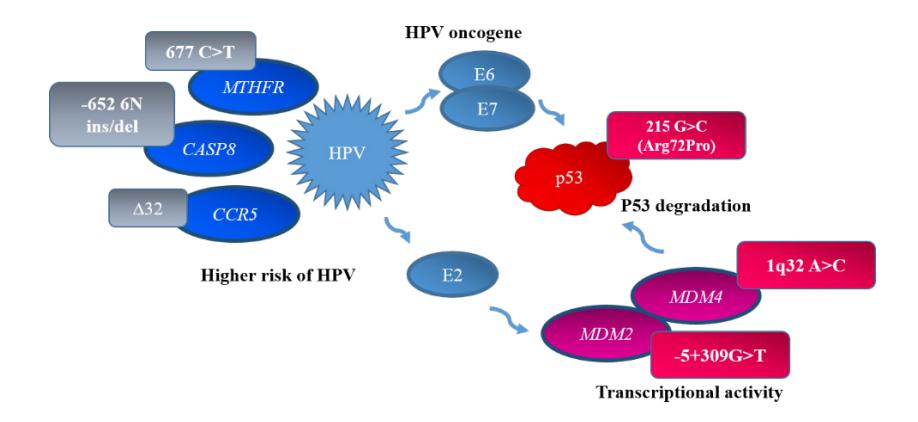
The aim of our study was to evaluate the distribution of HPV and different SNPs involved in the carcinogenesis and its impact to the NSCLC patients survival.
Results: HPV infection was stated only in three patients with NSCLC. After genes polymorphisms analysis it was found that patients with MDM2c.-5+309G>T gene T/G polimorfic variant had a better survival rate over patients with G/G and T/T variants (P = 0,383). A/A polymorphic variant of the MDM4c.1q32A>C gene resulted in a better survival rate of the lung cancer patients than A/C polymorphic variant (P = 0,836). C/T and C/C polymorphic variants of the MTHFRc.677 C>T resulted in similar survival rates as the ones observed in the same test group. Del/del allelic variant of CASP8c.-652 6N ins/del gene SNP led to lower survival rates, when compared to the ins/del and ins/ins allelic variants. The analysis of the $CCR5-\Delta32$ gene polymorphic wt/$\Delta32$ and wt/wt variations observed in >10% survival difference, better survival rate was noted in the patients who were identified with wt/$\Delta32$ polymorphic variant (P = 0.854). However all these differences were not statistically significant.
Conclusions: After cluster analysis, it was found that the best survival average median and better prognosis was noted in patients who were identified with CASP8 ins/ins and TP53 Arg/Pro polymorphic variants. Patients who were identified with CASP8 ins/ins and TP53 Arg/Pro gene polymorphic variants, survival rate was twice longer than those who were identified with MDM4 A/A, CCR5 wt/$\Delta32$, MTHFR C/T, MDM2 T/T genes polymorphisms.