Lately development of novel organic optoelectronic devices has been at the forefront of scientific interest due to promising convenient and easy solution based device fabrication [1]. Chemically engineered state-of-the-art organic molecules can produce desired optical and physical properties for suitable applications. Electronics based on organic semiconductors can be flexible, wearable, environmentally friendly and in some cases even outperform modern inorganic counterparts. Constantly developing major branches of organic electronics, such as organic light emitting diodes (OLED), organic thin film transistors (OTFT) and others, heavily rely on advanced semiconductor materials and their characterization. Perhaps one of the most essential parameters of fluorescent semiconductor materials used in optoelectronics is fluorescence quantum yield (QY), which determines materials scope to produce photons from energy absorbed.
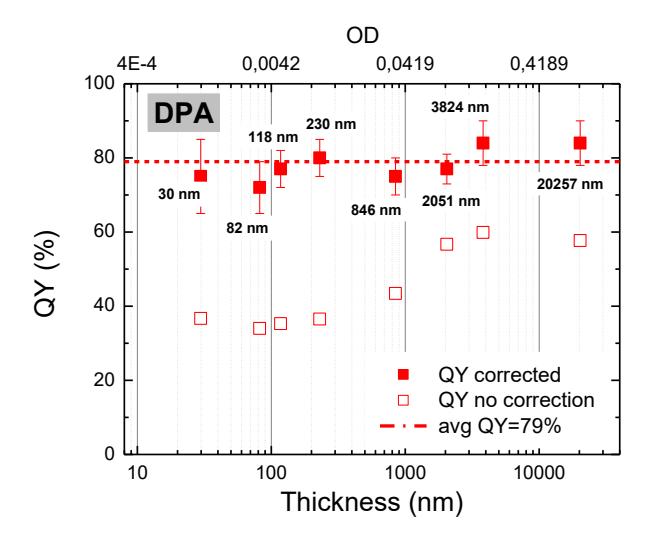
The current work focused on correct evaluation of QY in the films of organic compounds exhibiting different optical properties. The compounds were selected to have different Stokes shift (from 0.19 eV to 1.13 eV) and QY (from 43% to 79%). The series of films featuring identical compound concentration in polystyrene matrix (6 wt%) and continuously increasing thickness were prepared to deduce the influence of reabsorption on QY estimate. The QY measurements were carried out by using integrating sphere [2] where reabsorption is known to significantly alter QY data thereby preventing its correct evaluation. Our proposed QY evaluation method relies on the reconstruction of reabsorbed, i.e. spectrally distorted, fluorescence spectra (measured inside the sphere) by using the unperturbed spectra obtained outside the sphere. The results of the corrected QY along with the uncorrected data as a function of film thickness (optical density) are displayed in Fig. 1. Clearly, the effect of reabsorption drastically lowers QY of the films (see uncorrected data) as compared to those obtained by employing spectral reconstruction procedure. The reabsorption, obviously, makes QY of the film thickness-dependent. Conversely, spectral reconstruction implies correct QY estimates of the films independently on their thickness, and thus allows determining intrinsic material QY in the solid film.