
When developing a fast gas chromatography with negative-ion chemical ionization mass spectrometry (GC/NICI-MS) method matrix effects are a major issue. The effect of co-eluting compounds arising from the matrix can result in signal enhancement or suppression [1]. During the method development much attention should be paid to diminish matrix effects as much as possible. The present work evaluates matrix effects from whole blood and urine samples in the simultaneous analysis of fifteen benzodiazepines.
Therefore, the main aim of study was development of a new sensitive and specific method based on GC/NICI-MS using a mixed-mode solid phase extraction (SPE) for the identification and quantification of these drugs in biological samples. Moreover, the speed of the analytical separation was emphasized by modifying various GC/NICI-MS parameters. The fully validated method was applied for the quantification of several benzodiazepines in real whole blood and urine samples.
The proposed GC/NICI-MS method coupled with a mixed-mode SPE (a strong cation-exchange polymeric sorbent) and derivatization by N-(tert-butyldimethylsilyl)-N-methyltrifluoroacetamide:acetonitrile:ethyl acetate mixture (20:40:40 (v/v/v)) was shown to be useful for the analysis of benzodiazepines and their metabolites in biological samples. A derivatization step using different silylation reagents, duration, and temperature was investigated. This method is the fastest among the others reported up to now [1]. Under the optimized GC conditions derivatives of analytes were completely separated within 3.9 min, as shown in Fig. 1. Sensitive and specific NICI-MS detection combined with fast GC resulted in sharp and symmetric peak shape of the target analyte, while maintaining sufficient resolution (Fig. 1). Sample preparation conditions including selection of the solvent for washing and elution steps, pH values were also optimized. To the best of my knowledge, this method has been used for the first time for the optimization of sample preparation at pH 1.0.
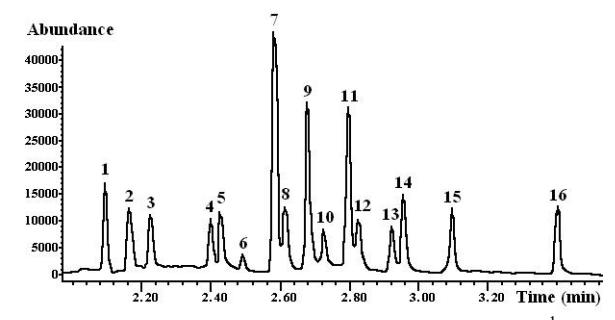
The developed method for 15 benzodiazepines determination in biological samples was validated following the recommendation for new methods [1,2]. The linear relationships with the correlation coefficients (r2) better than 0.9960 was evaluated. It was determined that extraction efficiency ranged from 82.9 (±6.2) % to 94.6 (±3.4) %. The precision (RSD) for benzodiazepines was 4.08 - 9.52 %, while the accuracy was in the range of 93.0 - 106.3 %. The developed method provides significant advantages in comparison with other previously published methods [1]. It shows higher sensitivity (the limit of detection ≤ 0.62 ng mL-1) in biological samples. Moreover, this method has several advantages: elimination of interferences (Fig. 1), low-volume of samples (0.2 mL) and a multi-residue analysis. According to the results, the developed GC/NICI-MS-SPE method is accurate, sensitive and specific enough to detect analytes after a long time use of a single oral administration of some drugs. Furthermore, this method enables to reach the highest specificity for major analytes and meets the requirements of good laboratory practice, especially when applied to pharmacodynamic investigations. Ultimately, the developed method has been applied in routine toxicological analysis during the investigation of both clinical and forensic cases.