III-nitrides semiconductor technology has undergone tremendous development and recognition. Numerous GaN-based devices, including light emitting diodes (LEDs), laser diodes, photodetectors and high power electronics, have emerged on the market. InGaN-based quantum well (QW) LEDs became important for solid state lighting [1, 2]. Yet, challenges such as creating green light LEDs still remain a major problem. Compared to the blue LEDs, green or yellow ones have lower efficiency. Attempts to manufacture effective LEDs emitting light at longer wavelengths are problematic due to increased defect density, high influence of carrier localization and the internal electric field. Du et al achieved a remarkable enhancement of emission efficiency for yellow-green LEDs by using multiple interruptions, while maintaining an unchanged ammonia flow. [3].
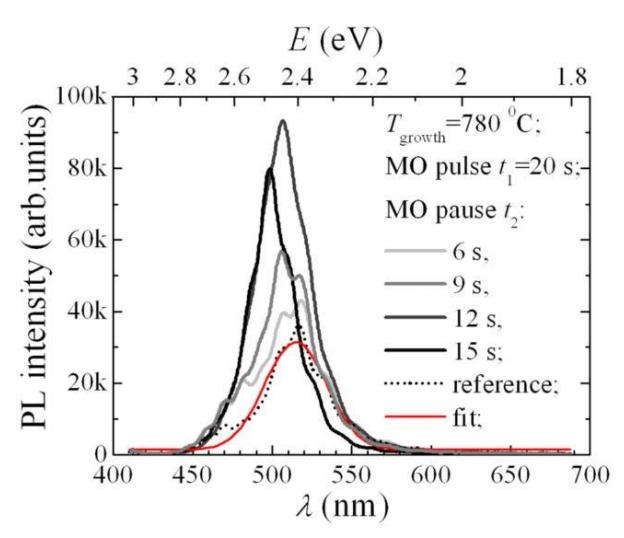
In this abstract, we present fully strained green light emitting InGaN/GaN multiple quantum wells, grown by metalorganic vapor phase epitaxy, using metalorganic (MO) precursor multiple flow interruptions during InGaN quantum well growth. Optimization of the interruption timing during the growth of QWs lets us reach the integrated photoluminescence (PL) enhancement up to two times for the green light emitting InGaN/GaN MQWs, when MO pulse durations is 20 s and pause durations is 12s (Fig. 1). The enhancement, as a function of pause duration, appeared to be pulse duration dependent: a lower enhancement can be achieved using shorter pulses with optimized relatively shorter pauses. Indium evaporation during the interruption time was interpreted as the main issue to keep the layers intact. Quantum wells revealing the highest PL enhancement were inspected for the interface quality, layer thickness, growth speed, strain, surface morphology and roughness by transmission electron microcopy, X-ray diffraction and atomic force microscopy techniques, and compared with the one grown in the conventional mode.