
Nanoantennas are nanostructured optical devices, metallic, dielectric, or even made of more exotic materials such as graphene, able to dramatically enhance the light-matter interaction [1]. This is due to their extraordinary ability to concentrate light in subwavelength spatial domains. A molecule placed into such hot spots interacts with a field of extreme strength. However, a nanoantenna can do much more. It allows to overcome paradigms that have been prevalent for long time when considering the light-matter interaction in free-space or in traditional cavities. There, it is assumed that the spatial extent of the molecule is much smaller than the wavelength of light; being a length scale for the spatial variations of the electric field. In consequence, the electric field can be considered as constant across the molecule. This allows to use the dipole-approximation where quantum state transitions are considered as purely electric dipolar. This assumption is
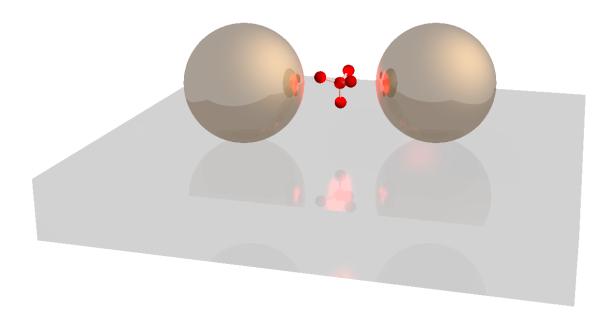
lifted by metallic nanoantennas [2, 3]. They provide not just huge electric fields but also huge electric field modulations, allowing to stimulate quantum state transitions that are usually considered as hardly accessible in free space: in this case magnetic dipolar transitions. We explore the possibility to superimpose them with the usually dominating electric dipolar ones and to coherently control the two pathways of the same transition. This may lead to circular dichroism induced in molecules that normally do not show this property.
For this purpose, we consider specific designs of metallic nanoantennas. Their spectral profiles and characteristics of scattered fields are calculated with a finite element method in the frequency domain. We investigate different multipolar contributions of a quantum transition between the ground and an excited state of specific molecules, using the Fermi golden rule:
$$\Gamma = \frac{2\pi}{\hbar} |\langle f|H|i\rangle|^2 \rho \left(\omega_f = \omega_i \pm \omega\right).\tag{1}$$Here $\Gamma$ is the modified transition rate between the initial state $|i\rangle$ and a final state $|f\rangle$, $\rho(\omega)$ is the density of states, and the $\pm$ sign corresponds to an absorption or an emission, respectively. The investigated interaction Hamiltonian $H$ combines the electric and magnetic dipolar contributions:
$$H = -\mathbf{d} \cdot \mathbf{E} (\mathbf{r}_m) - \mathbf{m} \cdot \mathbf{B} (\mathbf{r}_m),\tag{2}$$where $\mathbf{E}(\mathbf{r}_m)$ and $\mathbf{B}(\mathbf{r}_m)$ are the electric and magnetic fields at the position $\mathbf{r}_m$ of the molecule, while $\mathbf{d}$ and $\mathbf{m}$ are the molecular transition electric and magnetic dipole moments. Our goal is to exploit the nanoantenna to strongly enhance the magnetic field in its vicinity. Therefore, the magnetic transition mechanism of the molecule will be booste: instead of a negligible contribution at the absence of the nanoantenna it might even become comparable to the electric dipolar one. This is especially inetersting if a circularly polarized beam is used for illumination. The 90° phase shift between the electric and magnetic fields renders a different molecular response to illumination with right- and left-circularly polarized light. This is referred to as circular dichroism.