Naoual Al armouzi1, Mustapha Mabrouki1, Nourreeddine Kouider1
1 Laboratory of Industrial Engineering, Department of Physics, FST, University Sultan Moulay Slimane, Beni Mellal, Morocco
Copper oxide nanowires (CuO) have been synthesized by direct thermal oxidation of copper foils (Cu) in oxygen atmosphere. In comparison with chemical elaboration, the produced CuO nanowires by direct thermal oxidation have excellent crystallinity, and in addition than that, this method is simple, convenient and quick. The textural and structural properties of the films were characterized by atomic force microscopy (AFM) and X-ray diffraction (XRD). The effect of annealing temperature on the morphology of the nanowires is studied; it is found that the annealing temperature plays an important role in the morphology of CuO nanowires and the crystallite size of CuO. Synthesis conditions, such as, temperature and the nature of substrate which is of importance for practical applications.
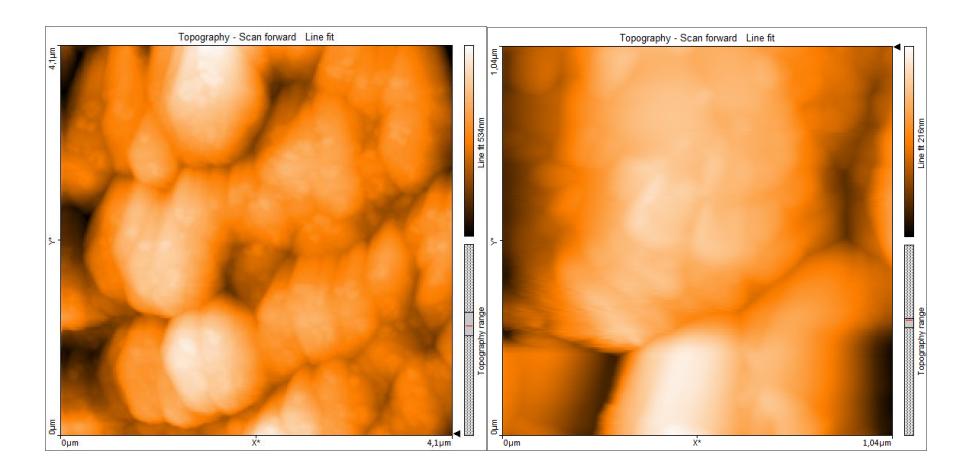
Fig. 1. AFM images for Cu annealing in 300°C and 600°C
[1] Farbod, M., et al. (2012). "Effect of growth parameters on photocatalytic properties of CuO nanowires fabricated by direct oxidation." Materials Letters81: 258-260.
[2] Dhanasekaran, V. and T. Mahalingam (2013). "Surface modifications and optical variations of (− 111) lattice oriented CuO nanofilms for solar energy applications." Materials Research Bulletin48(9): 3585-3593.
[3] Anandan, S., et al. (2005). "Room temperature growth of CuO nanorods arrays on copper and their application as a cathode in dye-sensitized solar cells." Materials Chemistry and Physics93(1): 35-40.
[4] Chandrasekaran, S. (2013). "A novel single step synthesis, high efficiency and cost effective photovoltaic applications of oxidized copper nano particles." Solar Energy Materials and Solar Cells109: 220-226.
[5] Wang, G., et al. (2012). "A review of electrode materials for electrochemical supercapacitors." Chemical Society Reviews41(2): 797-828.