The Bi polycrystalline films and coatings found many industrial applications the last years. Bi is being used in medical implants due to its biocompatibility. Bi electrodes promise to replace toxic Hg electrodes for potentiometry analytical chemistry methods. Bismuth coatings serves as protection from electro-magnetic pulses and some types of radiation. The Bi-based alloys can serve as thermoelectric materials in low-medium range of temperatures.
The applications mentioned above make the understanding of Bi-based systems electronic properties crucial for the scientific community. We have focused on polycrystalline Bi-based films. the most cheap and industrially attractive form of samples.
Our study consists of three main stages. First, we estimate the influence of grain boundaries on electric transport properties in pure Bi films. We've calculated mobilities and concentrations of charge carriers from measurements of Hall coefficient, Seebeck coefficient and magnetoresistance in temperatures range 4-300 K in magnetic fields up to 8 T. It was shown that precise control of mobilities is possible by the controlling of the mean crystallites diameter $(10^{-1} - 10^{1} \mu m)$. It was experimentally proved that character of resistivity temperature dependece may be switched from metallic to semiconductor one using the mentioned mechanism of mobility reduction [1].
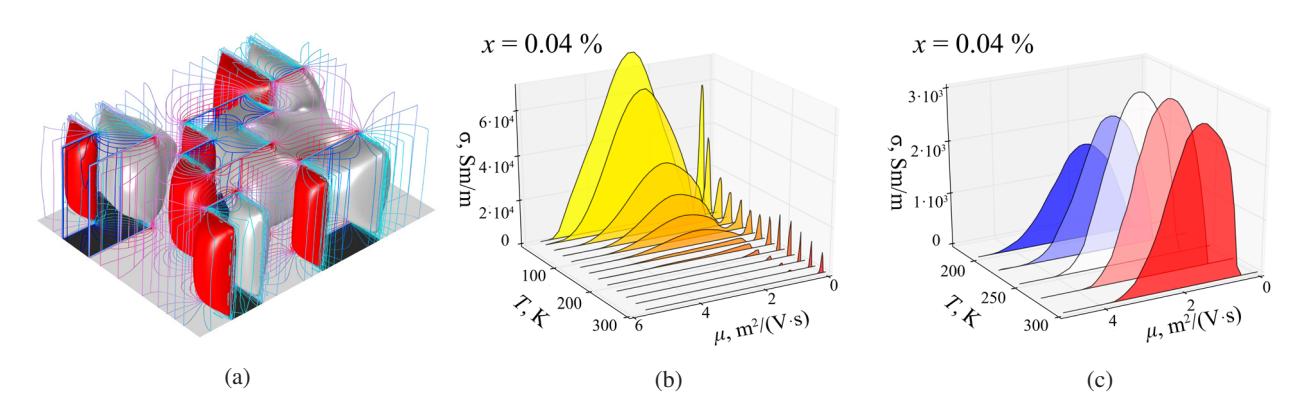
Secondly, we've developed the technique to predict Bi film Seebeck coefficient[2]. The model uses the Electron Backscatter Diffraction crystalline texture mapping as input data. Computation is based on differential equations in partial derivatives describing coupled heat and charge transfer (see Fig. 1(a)) with transport coefficients related to single crystal. The technique has succesfully proved itself for the samples with the grain sizes larger than mean free path of charge carriers.
Third, we've characterized the charge carrier parameters for Bix-Sn1-x alloys (x < 0.08 at. %), the promising can-didate for the p-type thermoelectric material. The standard galvanomagnetic methods of characterization through Hall coefficient and magnetoresistance are not suitable for those materials due to presence of several charge carrier types (up to three in some temperature region). To extract charge carriers mobilities and concentrations the Quantitative Mobility Spectrum Analysis code was developed with advanced error definition and Fourier-space adjustment mechanism (see Figs. 1(b,c)). The Fermi level position was estimated relatively to extrema of electronic bands in T- and L-points. It was shown that the temperature increase from liquid He to room fully compensates the effect of doping Fermi level shift for the T-point ellipsoid in k-space. However, the effect of Sn additions does not vanish with temperature for the L-point and becomes determinative for the electronic properties at room tepmerature.