
Laser propulsion became recently a hot topic due to the so-called “Breakthrough Initiative" led by a group of prominent scientists. Photonic thrusters for a long time have been recognized as very efficient for a propulsion of objects with speeds near to the speed of light c. However, they were also considered as quite inefficient due to their low specific thrust at low speeds [1]. Recently, this was addressed with introduction of a so-called "photon recycling" – situation, when a photon bounces many times inside a resonator, where one (moving) mirror is placed on a spacecraft and the second one remains static (see Fig 1(a)) [2]. Thus, a photonic thruster became a viable candidate for the "Breakthrough Initiative".
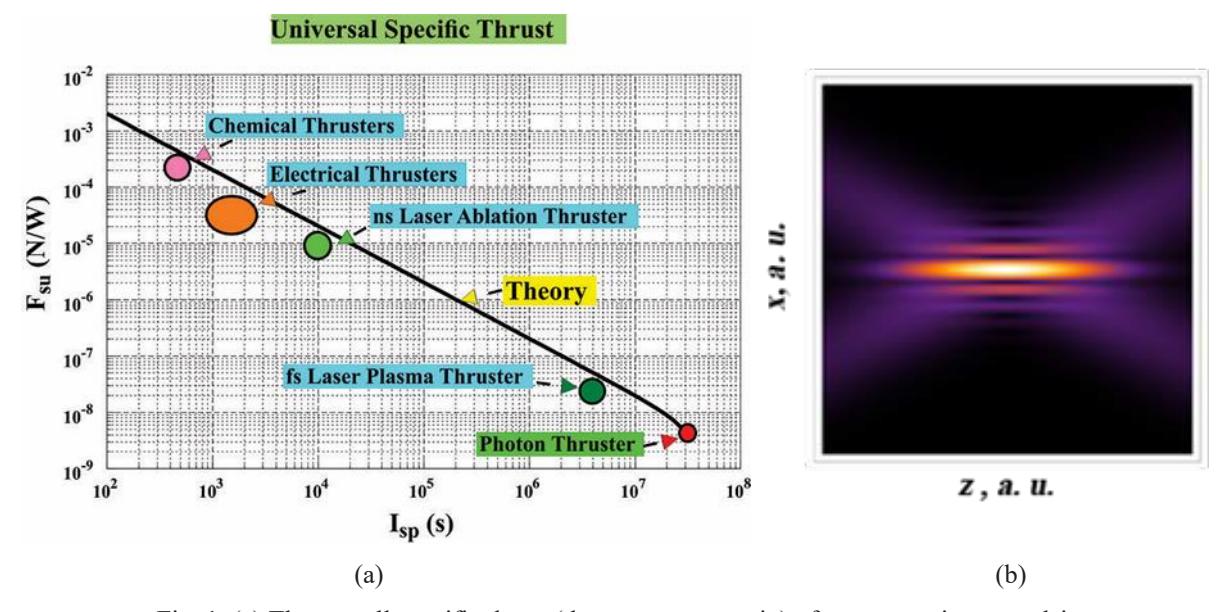
A combination of beams exhibiting long focal lines are called optical needles [3, 4]. Nondiffracting Bessel beam is a common example of the optical field, which can be perceived as an optical needle, (see Fig 1(b)). Here, we investigate a photonic thruster, enabled by a large scale Bessel-Gaussian beam. Such Bessel based photonic thruster can provide either constant or controllable thrust over large distances. In contrary, the thrust provided by a Gaussian impulse beam is decreasing as the spaceship moves away.
Further we analyze, how the combination of monochromatic superpositions of Bessel-Gaussian beams can be utilized to construct a desired on-axis distribution of the photonic thrust. We demonstrate our achievements in the control of photonic thrust and compare obtained efficiencies with that of a fundamental Gaussian mode.
Moreover, we discuss a practical implementation technique, which enables us not only to estimate sizes and shapes of photonic structures, but we discuss how to further optimize both the photonic thrust and its efficiency.