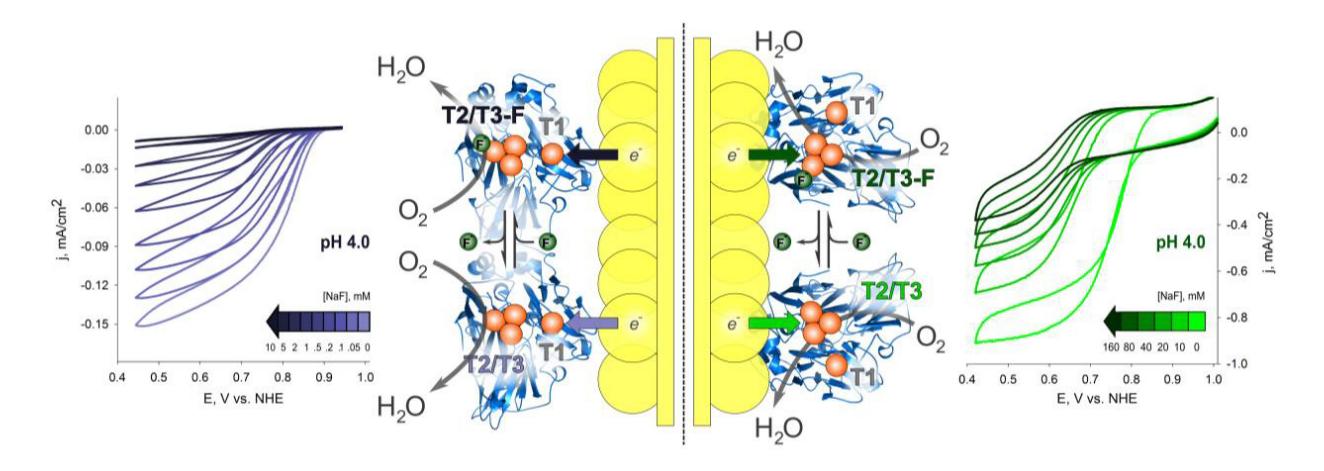
Oxygen reduction directly to water is a reaction of utmost importance in aerobes as well as in artificial systems like fuel cells. Such cells are comprised of two electrodes (bioanode and biocathode) with their surface containing immobilized enzymes which catalyze oxidation or reduction of compounds present in working solutions, while the electrons are taken or given directly to electrode surface. The resultant electric current is sufficient to power micro devices, when the system is working in complex media such as blood. Oxidoreductases are the enzymes suitable for synthesis of effective, selective and rapid action biofuel cells. However, enzymatic cathodes currently suffer from low performance and rapid inhibition. One of the main reasons is a complex electron transfer mechanism during the biodevice operation, which involves heterogeneous and intramolecular electron transfer reactions. The latter is the rate-limiting step in oxygen bioelectroreduction under physiological conditions, where a biofuel cell is supposed to operate.
We have developed a unique high-redox-potential enzymatic cathode able to operate in electrolytes with a broad pH range and in the presence of high concentrations of halogen ions, as well as presented proofs for its reaction mechanism [1]. The efficiency of adsorbed enzymes is higher than that in homogeneous catalysis, because of the change of the reaction rate-limiting step achieved by specific orientation of a nanometer-size biocatalyst on a nanostructured surface. Specifically, the trinuclear copper cluster (T2/T3) of the low molecular weight, naturally deglycolysed laccase from Didymocrea sp. is able to receive electrons needed for oxygen reduction directly from gold nanoparticle surface (Fig. 1). Meanwhile, all the previously published and utilized laccase biocathode systems relied on direct electron transfer between the surface and intermediate T1 copper cluster with related shortcomings – poor operation in physiological pH and in presence of halogen ions.