
Nowadays, people are getting more and more concerned about saving planet by reducing energy consumption and it was found that a huge amount of energy is being wasted due to inefficient street lighting installations. Therefore, the street lighting market is experiencing the technology changeover when old discharge lamps are replaced by modern LED based luminaires. In parallel to technology change, the expectations of customers and quality requirements evolve significantly requiring much more precise and profound design and development of lighting systems. Keeping in mind the vast need of street lighting renovation the main goal of the work was to develop the method of digital computing to identify the optimal parameters and theoretical limits of the lighting system designed for particular street and particular street lighting class.
Therefore, here we report the analysis of the street lighting standard EN 13201:2016 and methods for assessment of the optimal street lighting parameters under consideration. Several theoretical light spatial distributions were investigated and the "whale-tale" distribution selected for the modelling as the most versatile one. An automated routine generating a set of light spatial distributions (IES files), calculating all standardised lighting parameters and comparing them with EN 13201:2016 standard requirements was developed. The accuracy of the routine was tested in comparison with commercial software Dialux EVO and the errors did not exceed 1%. It is worth to be noticed that commercial lighting design software like Dialux EVO are perfect tools for design and visualization of the installations, but not suitable for optimization and automated modelling exercises performed in this work. Therefore development of the own digital computing application was a necessary part of this work.
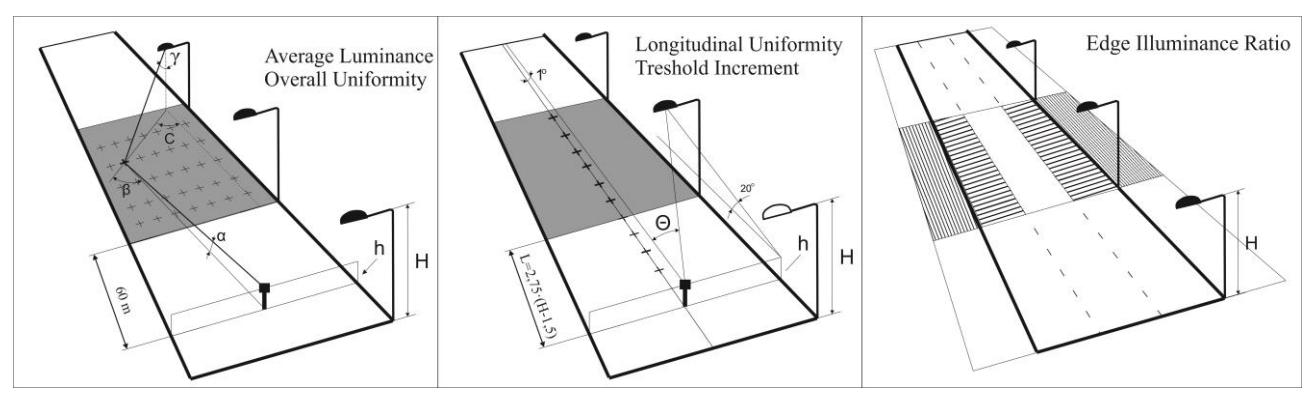
In conclusion, the most recent design street examples were modelled, lighting parameters optimized and limiting conditions for pole height and distance revealed.