
Internet traffic prediction is often required to ensure stable computer network functions. Traffic prediction is an irreplaceable tool for network optimization, prevention of malfunctions and attacks: it is necessary for adaptive applications [1], congestion control [2, 3, 4], planning of network infrastructure reconstruction [3] and attack detection [5].
The goal of this work is to achieve stable prediction of internet traffic by using nonlinear dynamics.
Internet traffic is quite unpredictable, is not periodic and cannot be described in a deterministic way. However, internet traffic is not completely stochastic: local self-similarity of the traffic flow [6, 7] helps to recognize a pattern, which allows the analysis of internet traffic by use of methods of nonlinear dynamics. By reconstructing a trajectory of the time series (the registered traffic) in a phase space it is possible to predict future values of the time series [8].
The main problem that occurs during such analysis is the determination of reconstruction parameters (delay $\tau$ and embedding dimension m). In this work delay is obtained using methods of autocorrelation, mutual information and time window and embedding dimension is obtained via false nearest neighbors and neural network methods.
A MATLAB code was written to determine the phase space reconstruction parameters (time delay and embedding dimension) and to predict the time series. In this work, common chaotic systems (Mackey Glass (Fig.1), Lorenz, Rössler) and internet traffic (Fig. 2) published by MIT (Massachusetts Institute of Technology) [9] were analyzed.
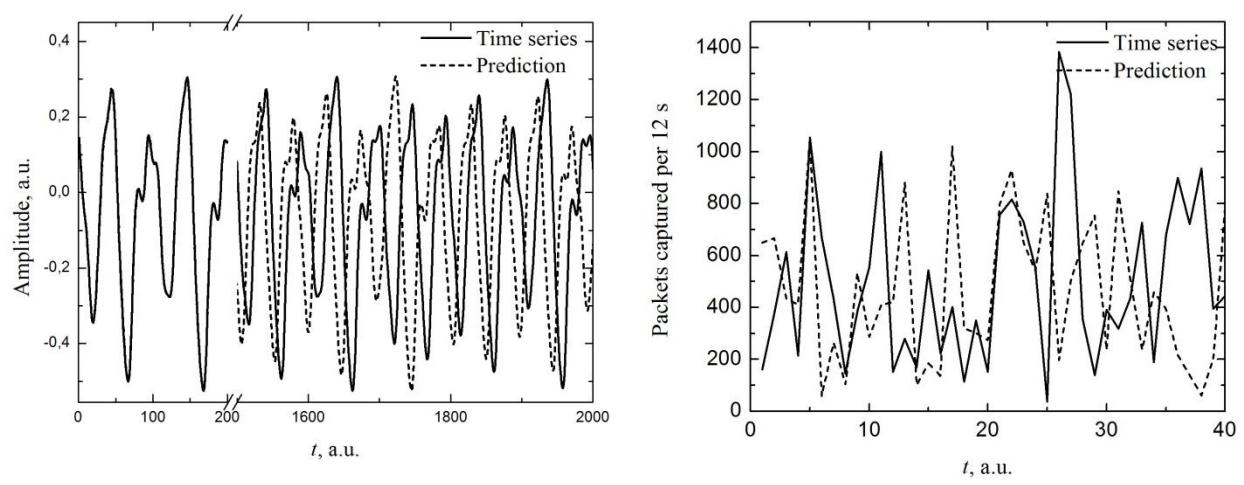
Main results and conclusions: 1) the analysis of the results of well-known chaotic systems has shown that with the optimal choice of phase space reconstruction parameters the prediction of up to 2000 points for chaotic time series is possible. The interval of maximum predictable amount of points (from a few to thousands) is mostly dependent on the choice of delay; 2) the analysis of different methods (autocorrelation, mutual information and time window) of obtaining the reconstruction parameter delay has shown that there is no single method of delay evaluation suitable for all chaotic systems; 3) only a short time prediction is available for internet traffic. Further investigation is needed in the determination of optimal and reasonable phase space reconstruction parameters.