
Experiments with ultracold quantum gases in recent years have come down to such low temperatures, that the effect of both classical and quantum fluctuations is noticeable. Therefore it became necessary to improve methods for numerical simulations that can let quantum fluctuations survive in the new physical regime. Several methods, which give promising results and represent the two types of fluctuations, have been proposed so far. However, they are unstable (Positive P) or lead to the equilibrium state which is not fully correct (Truncated Wigner). The aim of the study was to determine the physical constraints on the range in which the correct many body quantum state can be obtained by the Truncated Wigner method. To this end we have characterized an equilibrium states of Wigner stochastic equations and their properties.
Ultracold gases at non-zero temperatures are fairly well described by the Stochastic Gross Pitaevskii Equation (SGPE)[1,2,3]:
$$ \hbar \frac{\partial \varphi(x)}{\partial t} = -i(1 - i\gamma) \mathcal{L}_{GP} \varphi(x) + \sqrt{2\gamma \hbar k_B T} \eta(x, t), $$ $$ \langle \eta(x, t)^* \eta(x', t') \rangle = \delta(x - x') \delta(t - t'), \qquad \mathcal{L}_{GP} = -\frac{\hbar^2}{2m} \nabla^2 + V(x) - \mu + g |\varphi(x)|^2.\tag{1} $$Equation (1) does not include quantum fluctuations which become important at lower temperatures.
WSGPE evolution equation (recently developed):
$$ \frac{\partial \varphi(x,t)}{\partial t} = -i(1-i\gamma)\left(-\frac{1}{2}\frac{\partial^2}{\partial x^2} + V(x) - \mu + g\left(|\varphi|^2 - \frac{1}{\Delta x}\right)\right)\varphi + \sqrt{\gamma(2T + E - \mu + \frac{g}{\Delta x}\left(|\varphi|^2 - \frac{1}{\Delta x}\right)}) \eta(t). \tag{2} $$Equation (2) includes also quantum fluctuations.
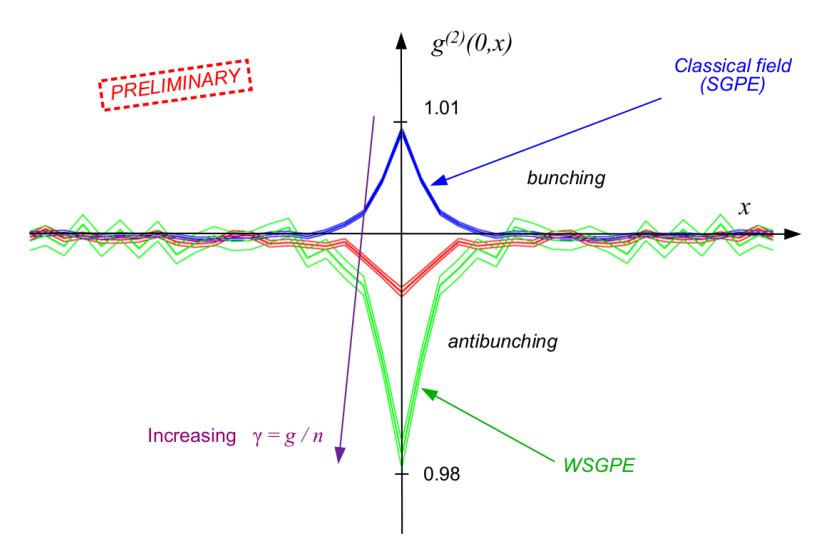
We have studied the local (one-mode) stationary solution in detail and found its asymptotic behaviours when the number of particles is large and when it is small. Importantly, we confimed that the virtual vacuum noise characteristic for quantum fltuations in the Wigner description is present even in the stationary solution. This is something that could not be achieved with previous standard truncated Wigner simulations.