
Polyoxometalates are a class of metal oxide clusters of early transition metals (V, Mo, W, Nb, etc.), and they show strong Brönsted acidity, fast reversible multi-electron redox transformations under mild conditions, and adjustable acid-base and redox properties over a wide range. Therefore, the use of POMs as acidic and redox-bifunctional catalysts in homogeneous and heterogeneous systems is their most popular and important application area. Thus, cerium decatungstate [CeIV(W5O18)2]8– modified with cetylpyridinium cations was found to be an active and selective catalyst for the oxidation of secondary alcohols to ketones with hydrogen peroxide [1].
In present work we have studied the interactions of cerium (III) chloride with aqueous solutions of Na2WO4 at various acidity $Z = \nu(H^+)/\nu(WO_4^{2-}) = 0 – 1.50$. As known [2], during them isopoly tungstate anions of different composition $[H_{m-2k}W_nO_{4n-k}]^{(2n-m)-}$ are formed.
Presence of Ce(III) ions and other lanthanide ions can lead to the formation of heteropoly anions [3-4]:
$Ce^{3+} + 10 WO_4^{2-} + 8 H^+ \leftrightarrows [Ce(W_5O_{18})_2]^{9-} + 4 H_2O, (Z = 0.80);$
$2 Ce^{3+} + 22 WO_4^{2-} + 30 H^+ \leftrightarrows [Ce_2(H_2O)_{10}W_{22}O_{72}(OH)_2]^{8-} + 4 H_2O, (Z = 1.36).$
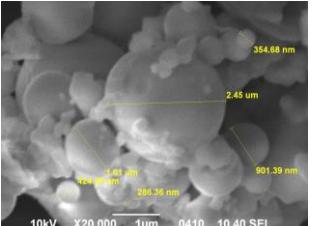
From aqua-acetone media (v/v = 50/50) at Z = 0.80 the sodium heteropoly decatungstocerate (III) Na9[Ce(W5O18)2]·28H2O with Peacock-Weakley anion structure was synthesized. From acidified up to Z = 0.80 aqueous solution of sodium tungstate without acetone adding the acid sodium heteropoly decatungstocerate (IV) Na6H2[Ce(W5O18)2]·30H2O with Peacock-Weakley anion structure was synthesized. Salts of these heteropoly compounds have different micromorphology (Fig. 1) and different positions of vibration maxima in the FTIR spectra (FTIR data for Na9[Ce(W5O18)2]·28H2O, cm-1: 416, 485, 542, 575, 711, 787, 845, 955; FTIR data for Na6H2[CeIV(W5O18)2]·30H2O, cm-1: 436, 491, 553, 583, 677, 783, 828, 941).
From the solution with Z = 1.00 the cerium heptatungstate Ce2W7O24·20H2O was synthesized, and by XRD it was shown that it thermal decomposition accompanied with crystallization of Ce4W9O33 and WO3 phases.
By the chemical analysis and FTIR spectroscopy it was shown that the Ce5[HW7O24]3·56H2O was synthesized from solution with Z=1.17, and by XRD method it was shown that calcination of Ce5[HW7O24]3·56H2O at 500°C occurs with only WO3 phase crystallization, and calcination at 700°C accompanied with crystallization of Ce4W9O33 phase. By the chemical analysis and FTIR spectroscopy it was shown that the cerium paratungstates B-Ce10[W12O40(OH)2]3·94H2O and Na10Ce20[W12O40(OH)2]7·180H2O were synthesized from equilibria solutions with Z=1.17 and 1.29, respectively, and Na2Ce2[Ce2(H2O)10W22O72(OH)2]·35H2O with lacunar metatungstate-anions as ligands was synthesized from the solution at Z=1.364.