
Phosphor-converted light-emitting diodes (pcLEDs) are designed for outdoor lighting applications, because a better luminous efficiency of radiation (LER) can be achieved compared to traditional high intensity discharge (HID) lamps. Typically all LED based luminaires are enriched in blue light, which is found to have influence on suppressing sleep hormone - melatonin production. Lack of melatonin in the evening can disrupt human circadian rhythm causing sleeplessness, which can lead to insomnia and other sleeping disorders. The property of the spectral power distribution (SPD) of a light source to suppress the production of melatonin can be characterized by the circadian action factor (CAF). Higher CAF values indicate the increased suppression and vice versa. Luminaires with pcLEDs are an alternative to luminaires of multicolor LEDs, especially in low illuminance lighting applications, where broad orange spectra of phosphors can provide less blue-light pollution and thus achieve lower circadian action, while having better color rendition index (CRI) and the potential to save energy [1,2].
In this work, solid state lamp prototypes for outdoor lighting were designed by using a royal-blue LED (440 nm), a reflector and a remote phosphor converters. The reflector was made of a cone shaped white plastic for even light distribution. The phosphor converters were made from phosphors powders and silicone mixes. Commercial Intematix (05446 and 06040) and PhosphorTech (BUVOR02) orange phosphors were used. The concentrations of investigated phosphors converters were between 15 wt% and 35 wt% and the thicknesses of the converters varied between 0.5 mm and 1.6 mm. The prototypes SPDs were measured and compared with each other in order to find the optimal concentration and thickness for white light generation. For the best prototypes LER, CAF and CRI were calculated. Optimal phosphors concentrations and thicknesses of the converters for each phosphor were: 35 wt% and 1.2 mm for BUVOR02 (1), 20 wt% and 0.8 mm for 05446 (2) and 20 wt% and 1.2 mm for O6040 (3). The xy CIE chromaticity coordinates of the mentioned light sources are presented in Fig. 1.
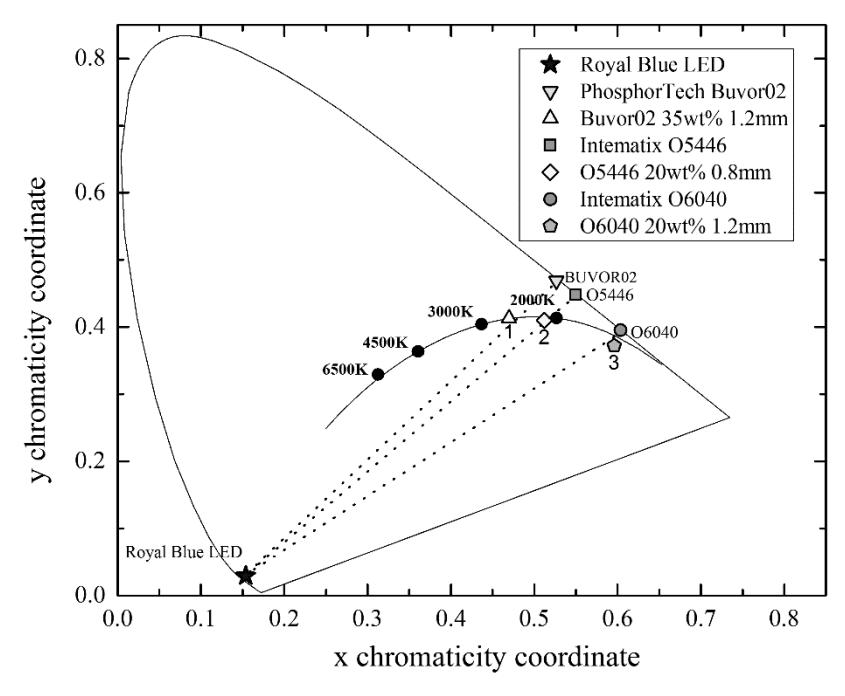
Designed prototypes light is perceived as white because of small distances from the Planckian locus (Duv < 0.02). Evaluated CRI values are better than typical HID lamp values. Prototype with 05446 and O6040 can be called firelight because of their extra low CCTs and can provide more visual comfort and lower circadian action for low-illuminance night lighting applications.