Although the Standard Model (SM) like Higgs boson was discovered in 2012 with the combined measured mass $m_{h} = 125.09 \pm 0.21 (\text{stat.}) \pm 0.11 (\text{syst.})$ GeV [1] based on data from the ATLAS and CMS experiments, there is still no experimental verification that it is the only Higgs boson. Therefore there is still place for extending the SM. One of the simplest extensions of the SM Higgs sector is the two Higgs doublet model (2HDM). In the 2HDM a second complex SU(2)-doublet is added, which leads to eight scalar fields in total. Out of these fields, five different physical Higgs bosons are generated: two neutral CP-even Higgs bosons $h$ and $H$, a neutral CP-odd Higgs boson $A$ and a pair of charged Higgs bosons $H^{\pm}$.
During our research we performed both theoretical and numerical analyses of the CP-conserving 2HDM. The generic basis and the physical mass-eigenstates basis were scrutinized. For the numerical analysis the two Higgs doublet model calculator (2HDMC) [2] was used. In order to check how the 2HDMC works a test run of $10^{7}$ points was performed. To achieve that a random number generator (RNG) was implemented along with changing the input format to a convenient form. The theoretical analysis of the model was also performed based on works by Haber [3]. Theoretical and numerical results were compared to get an idea of possible limits of the 2HDM.
The RNG algorithm was constructed to increase efficiency of computing. The algorithm is based on the physical mass-eigenstates basis. The input is the following:
4 physical masses : $m_{h}$, $m_{H}$, $m_{A}$, $m_{H^{\pm}}$
2 mixing angles : $\alpha$, $\beta$
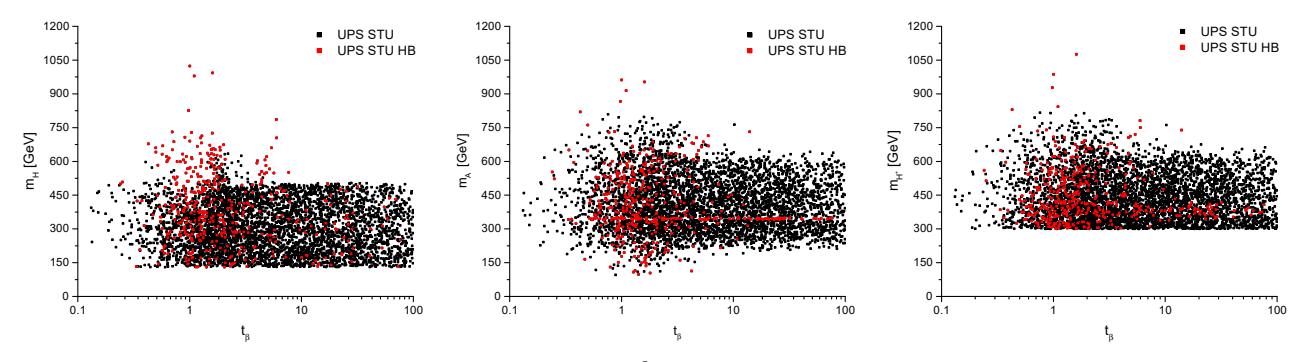
First of all, three constraints of the 2HDM potential are checked: stability, S-matrix tree-level unitarity and quartic Higgs boson perturbativity. Based on these calculations and additional limits coming from Higgs bosons masses the range for the value of the coupling coefficient $m_{12}^{2}$ is determined. Afterwards it is randomly chosen if parameter point is possible. We call this test the UPS check.
Secondly, if a parameter point passes the UPS check, the oblique parameters [4] S, T and U are estimated. Their values are compared with the ones from the Gfitter group [5]. In our analysis we inspect these values directly without correlation coefficients between the S, T, and U parameters.
Finally, the decay rates are checked. For this check the program Higgs Bounds (HB) [6] is used. Of particular interest is the Type-III 2HDM in which the second 2HDM doublet Yukawa couplings are chosen freely. Such choice allows for flavour changing neutral currents. We check the fermiophobic model where the second 2HDM doublet Yukawa coupling values are zero.