
Ionic liquids (ILs) has become extremely attractive study material in spectroscopy due to their variable abilities and wide range of applications. Most notably, ionic liquids are great designer solvents, as their abilities can be tuned to match a specific solute and negligible vapor pressure let them serve as "green" solvents by replacing volatile and toxic industrial solvents.
It is crucial to study the effects water on ionic liquids, because water, as a co-solvent or impurity, can drastically change the properties of ionic liquids and even hydrophobic ionic liquids tend to absorb water from atmosphere [1]. The main goal of this work was to investigate the effect of two specific room temperature ionic liquids, namely 1-butyl-3-methylimidazolium bromide and nitrate, on O-H stretch band of water using polarized Raman spectroscopy.
There are three O-H stretch band components, namely: $v_{3270}$, $v_{3450}$ and $v_{3650}$ corresponding to network forming (strong H-bonds), intermediate (weaker H-bonds) and free (no H-bonds) water O-H stretch bands, accordingly [2].
Three slope change points (at $X_{\text{H}_2\text{O}}$=0.4$\pm$0.02, $X_{\text{H}_2\text{O}}$=0.68$\pm$0.02 and $X_{\text{H}_2\text{O}}$=0.84$\pm$0.02) were determined in the $S_x / (S_{3270}+S_{3450}+S_{3650})$ integral intensity ratio for [BMIM]Br/H2O mixture and two (at $X_{\text{H}_2\text{O}}$=0.38$\pm$0.02 and $X_{\text{H}_2\text{O}}$=0.6$\pm$0.02) for [BMIM]NO3/H2O mixture as the free water O-H band component in the latter mixture formed only in very high water concentration.
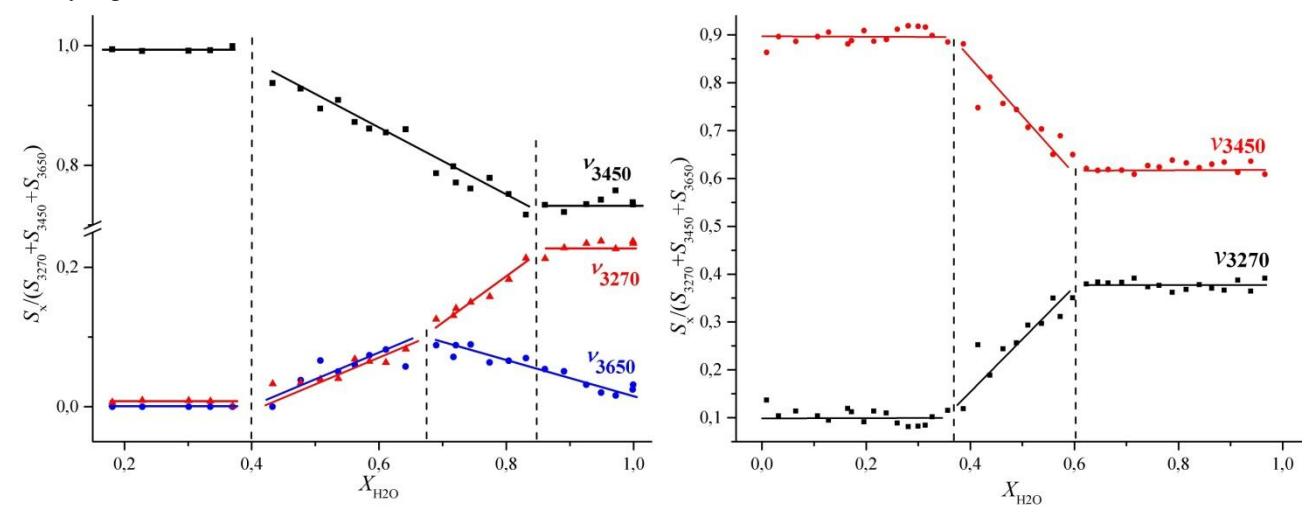
The slope change point at $X_{\text{H}_2\text{O}}$=0.4$\pm$0.02 in the case of both ionic liquids is probably due to the start of forming of network water. The change point at $X_{\text{H}_2\text{O}}$=0.84$\pm$0.02 for [BMIM]Br/H2O and at $X_{\text{H}_2\text{O}}$=0.6$\pm$0.02 for [BMIM]NO3/H2O could be attributed to the weakening of ionic liquid polar network and simultaneous increase in both network and intermediate water.
Moreover, the polarized Raman spectra of the ionic liquid aqueous solution were measured and the depolarization ratios for $v_{3270}$ and $v_{3450}$ O-H bands were determined. For the [BMIM]Br/H2O mixture, the $v_{3270}$ band's depolarization ratio is 0.2$\pm$0.15 and remains nearly constant throughout the whole concentration range, whereas $v_{3450}$ band's depolarization ratio decreases from 0.3$\pm$0.1 to 0.1$\pm$0.05 upon water fraction increase. In the case of [BMIM]NO3/H2O mixture - the $v_{3450}$ band the depolarization ratio is 0.05$\pm$0.02 and remains constant throughout the whole concentration range, while $v_{3270}$ band's depolarization ratio has a break point at $X_{\text{H}_2\text{O}}$=0.5$\pm$0.1. The symmetry changes could be due to the growth of symmetric anion-water complexes, but further analysis is required to be certain.