
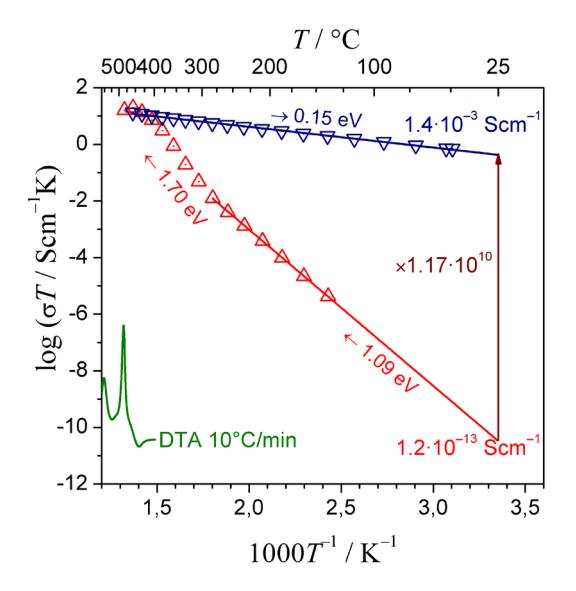
Since the pioneering publication by J.B. Goodenough et al. [1], phospho-olivines LiMPO4 (M = Fe, Mn, Co, Ni) had been studied for their application as cathodes for Li-ion cells. From the whole family of isostructural compounds, only cathodes prepared from LiFePO4 had been introduced into mass production. LiMnPO4 cathode has higher potential versus metallic lithium compared to LiFePO4, but synthesis of LiMnPO4 compounds which can work in cathodes with high loads is more difficult [2]. One of the applied ways is to prepare nanomaterials with non-stoichiometry [3]. Other possible way is to synthesize LiMn1-xFexPO4 phospho-olivines [4]. In recent years, J.E. Garbarczyk and co-workers have proposed and investigated an alternative route to the conductivity enhancement, namely a thermal nanocrystallization of glassy analogs of the important crystalline cathode materials [5, 6], such as: V2O5, LiFePO4 and Li3V2(PO4)3. The advantages of our approach to produce active cathode materials include the absence of carbon additives and simplicity and straightforwardness of synthesis, which consists of two stages only: (i) glass preparation by melt-quenching and (ii) thermal treatment of the glass to induce its nanocrystallization. Our experience with that method has shown that one can, by the appropriate heat-treatment, achieve a huge (even by a factor 109) and irreversible conductivity enhancement.
In this research, we aimed to replace some of iron ions in LiFe0.80V0.08PO4 with manganese in order to obtain highly conductive nanomaterial. Appropriate amounts of precursors: Li2CO3, FeC2O4·2H2O, Mn(CH3COO)2·4H2O, (NH4)H2PO4 and V2O5 were mixed in a mortar, melted at 1300 °C and rapidly quenched. Their amorphousness was confirmed with X-ray diffractometry (XRD) and thermal events occurring in the sample were observed with differential thermal analysis (DTA). Electrical conductivity was measured upon heating and subsequent cooling with impedance spectroscopy within wide frequency range 10 mHz – 10 MHz.
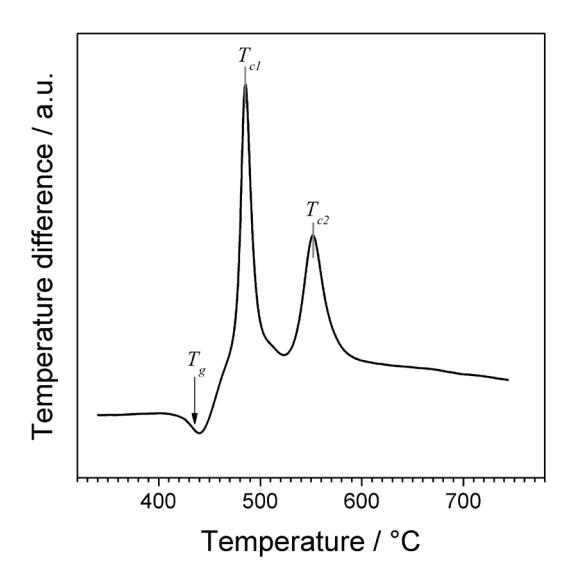
DTA curve of as-received sample was typical for glassy material (Fig. 1). A glass transition at Tg = 433 °C and two crystallization peaks (Tc1 = 485 °C and Tc2 = 552 °C) were observed. Preliminary electrical results (Fig. 2) showed that initial conductivity (1.2·10-13 Scm-1) can be increased of at least 10 orders of magnitude to 1.4·10-3 Scm-1.