
Low-molar-mass and polymer organic light emitting diodes have attracted considerable attention due to their great application potential in large area flat panel displays and solid state lighting [1]. Such devices tend to have multilayer device configuration with a hole transport layer, an electron transport layer and an emissive layer, and some of them also have a hole injection and an electron injection layer [2].
The selection of appropriate materials for each layer is of great importance. Generally, the molecular structures of hole transport materials usually contain electron-donating moieties, such as carbazole, triarylamine, diphenylamine, N-phenyl-1-naphthylamine etc. [3]. However, most of the methods used for the synthesis of electroactive materials suffer from one or several drawbacks such as low yields, prolonged reaction times, use of hazardous, expensive, moisture-sensitive, and large quantity of reagents, involving harsh reaction conditions, tedious workup procedure, and difficulty in recovery, and reusability of the catalysts. Therefore, there is a need to develop efficient and versatile methods for the synthesis of electroactive compounds.
In this work we employed efficient regioselective acid-catalysed reactions of 1H, 1-methyl- and 1-naphthylindole with o-phthalbenzaldehyde [4]. New indole and benzo[b]carbazole derivatives (Scheme 1) were synthesized and investigated in order to identify correlations between the molecular structures of the compounds and their optical, electrochemical and photophysical properties. DFT calculations employing the B3LYP functional were performed in vacuum with the Spartan'14 program [5]. Neutral cationic and triplet state geometries of molecules were optimized from conformational analysis data as starting point using 6-31G (d,p) basis set. The newly synthesized derivatives were find to be suitable for the active layers of organic light-emitting layers.
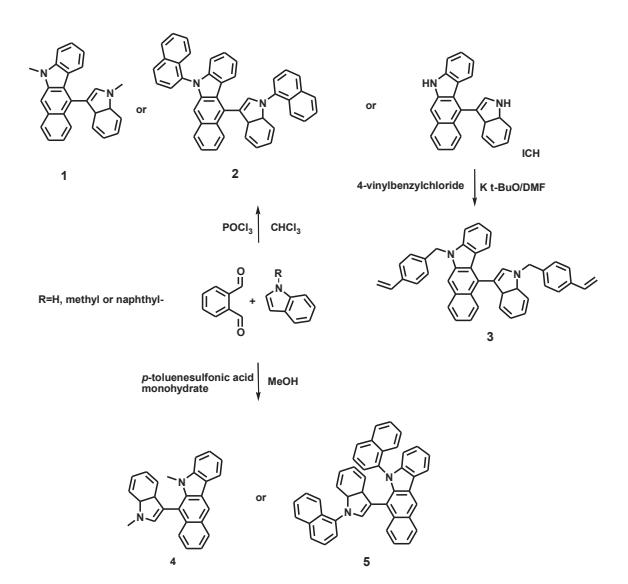
The thermal, optical, photophysical, electrochemical and photoelectrical properties of the materials, as well as photo- and thermally activated polymerization of the monomer containing vinyl group monitored by FTIR will be reported.