
Ferrites have been widely studied due to their diverse potential applications including telecommunication device, ferro-fluid technology, chemical sensor, electrophotographic developer, hyperthermia treatment, drug delivery, and magnetic resonance imaging [1, 2].
As magnetic nanoclusters, which have a low (even zero) coercivity over a wide range of particle sizes, exhibiting desired magnetization can be useful in a broad range of applications [3].
In this work, we studied Mn-ferrites because of their promising magnetic properties. As seen in Fig. 1, Mn-substituted ferrites are characterized by a high magnetization at room temperature.
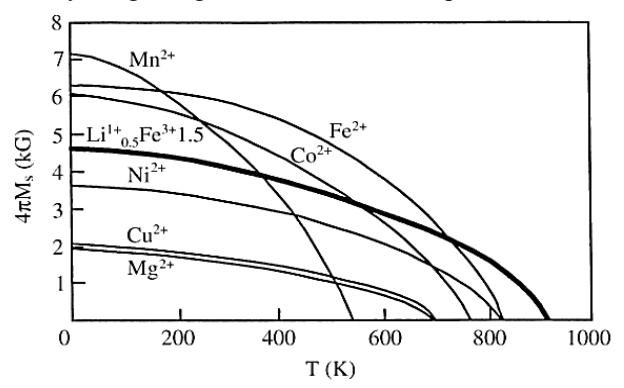
The magnetic properties of Mn-ferrites are known to depend on their phase composition and other structural features. The studied ferrites are MnxFe2-xO4 solid solutions differing in structural and concentration inhomogeneity. To achieve the best magnetic characteristics, the preparation of a product consisting of single spinel-type phase with no traces of individual iron or manganese oxides is required. The oxidation state manganese and iron cations, and manner of their distribution over the spinel crystal lattice also influence the magnetic behavior of the Mn-ferrites. According to the Neel theory, maximum magnetization value is reached when bivalent cations (Fe2+, Mn2+) occupy tetrahedral positions of the spinel lattice, while trivalent cations (Fe3+) – octahedral ones [5].
During the synthesis, it is very important to consider the possibility of Mn2+ → Mn3+ oxidation reaction, which influences the ferrite properties. In the technological cycle of the ferrite fabrication, Mn2+ → Mn3+ oxidation reaction may occur at high temperature, which is likely accompanying by a reduction of Fe3+ ions to Fe2+ state, and also by a redistribution of the metal cations between the sublattices. Namely, a partial swap of the generated Fe2+ and Mn3+ ions between tetrahedral and octahedral lattice sites is possible. The described processes have an adverse effect on the magnetic features of the material [5]. In our work, we used low-temperature co-precipitation method of synthesis, which allows avoiding undesired oxidation reactions. A series of MnxFe2-xO4 ferrites with x = 0 ÷ 1.5 has been synthesized. The structural features and the magnetic properties of the prepared materials have been studied.
In order to prepare MnxFe2-xO4 ferrites, a combined hydrolysis of Fe3+, Fe2+ and Mn2+ salts with NaOH was used. The metal salts were taken in the corresponding proportions. The suspension was stirred for 1 h followed by magnetic decantation and drying.
Transmission electron microscopy shown that all the samples consist of nearly spherical particles with an average size of about 10 nm and low polydispersity index.
According to X-ray diffraction analysis, the powders of MnxFe2-xO4 were single-phased and had a spinel structure up to x = 1. Individual MnO2 phase was distinguished in the diffraction patterns of the powders with x > 1.
The magnetic properties of the prepared samples have been estimated. The saturation magnetisation values were measured to be in the range of 50–65 emu/g. All the powders were superparamagnetic at room temperature.