
The vitality of hadronic calorimeters will be very important for the next generation of collider experiments with high luminosity such as future upgrade of the Compact Muon Solenoid (CMS, CERN) for Large Hadron Collider (LHC, CERN) and Future Circular Collider (FCC) experiment. The FCC would enable proton-proton collisions of 50 TeV center of mass with the present 8.3-T LHC magnets, of 100 TeV with 16-T magnets [1]. The FCC-hh design baseline aims at a peak luminosity $5\cdot10^{34}$ s-1cm-2 of i.e., the same value as for the LHC luminosity upgrade (HL-LHC) [2].
Radiation damage in experiments at high-luminosity accelerators will play a significant role as limiting factor of the long term stability when operating an experimental setup. In this work we estimated fluence of the high energy protons in the high pseudorapidity region which will reach hadronic detecting blocks depending on the construction of the detector. Following configuration were considered: electromagnetic + hadronic calorimeters (ECAL + HCAL) of the CMS at LHC, spaghetti-type calorimeter (SPACAL) and “shaslyk” sampling-calorimeter + HCAL. We considered three geometry configurations using GEANT4-based simulation toolkit [3], where modules were bombarded by 10, 25, 50, 100 GeV protons.
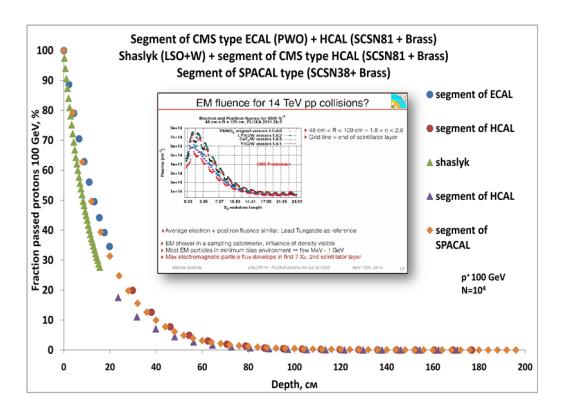
Our investigations have a good agreements with data, obtained in [4] – the residual proton fractions after ECAL is ~10-20% in comparison with initial flux. As in a case of PbWO4 there are not any addition damage mechanisms under hadron irradiation in the wide energy range 200 MeV – 1 TeV [5] for plastic scintillators.
The obtained data show that in case of high luminosity LHC and FCC experimental facilities the organic plastic material of hadron calorimeter will be vastly damaged by residual hadrons after ECAL-regions, especially in the near beam area of calorimeter (pseudorapidity $\eta$=1.6-3) during the first year of operation if the parent hadron flux will be higher than ~1013-1014 s-1cm-2 [6].
A possibility to apply inorganic scintillation materials in hadron calorimetry is discussed.