Materials showing large magneto-optic effects have application in wide range of optical technology as fast shutters, switches, tunable phase retarders, etc [1]. Stable ferrofluids made of suspended cobalt nanoparticles are especially interesting due to their magnetic and magneto-optical properties. In this study we measure optical properties of suspension of such nanoparticles in toluene and cyclohexane in the presence of magnetic field and analyze the results with a theoretical model.
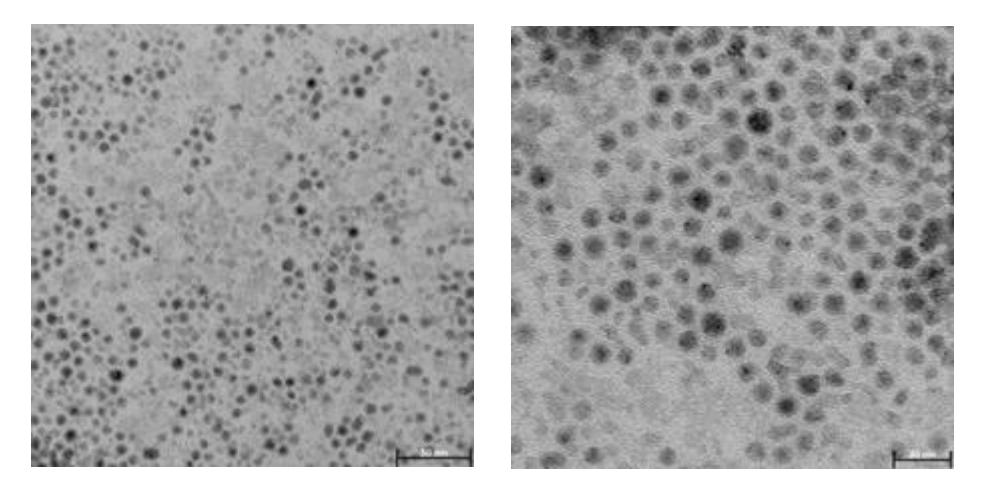
Cobalt magnetic nanoparticles were synthesized in o-dichlorobenzene via thermal decomposition of cobalt octacarbonyl under inert (Ar) atmosphere in a presence of oleic acid (OA), trioctylphosphine oxide (TOPO) and triphenylphosphine (TPP) [2]. Then the nanoparticles were precipitated using ethyl alcohol and dispersed in toluene and cyclohexane. The diameter of the nanoparticles was determined by SAXS (Small-angle X-ray scattering) while shape with TEM (Figure 1). The ratios of surfactants enabled to synthesize nanoparticles with different diameters.
The Faraday effect in the solution was observed. Polarized laser light was transmitted through the sample placed in magnetic field (from 0 to 0.4 T) and recorded using polarimeter. The analysis of the rotation angle compared with theoretical model provides the information about the effective size of the magnetic core [3], which corresponds with accuracy about 1 nm to the actual size of the nanoparticles.