
Matrix isolation methods are very useful for investigating individual molecules and their clusters. It is believed that due to its small size the molecule of water can be in the excited rotational and vibration-rotational states in an isolating matrix in the case of small values J'' and J'. The state of the molecule, which can be considered as an asymmetric top with some effective values of the rotational constants ($A_{v_{1}v_{2}v_{3}}$, $B_{v_{1}v_{2}v_{3}}$, $C_{v_{1}v_{2}v_{3}}$), can be described by the following set of quantum numbers ($v_{1}v_{2}v_{3}$, $J_{k_{a}k_{c}}$), where $v_{1}$, $v_{2}$, $v_{3}$ are vibrational quantum numbers characterizing symmetric stretching, bending and asymmetric stretching vibrations of O-H bonds, respectively, and $J_{k_{a}k_{c}}$ - standard set of quantum numbers describing the rotational state of an asymmetric top. Recently [1], we analyzed the rovibrational spectrum of the water molecule trapped in Ar matrix in $v_{2}$ region using effective values of the rotational constants from [2,3]. The intensity of a vibration-rotational transition can be calculated using the formula:
$$I_{i \to f} = \frac{\left(2\pi\right)^{3} N \tilde{v}_{if} g_{s(i)} \left[ e^{\frac{-E_{i}}{kT}} - e^{\frac{-E_{f}}{kT}} \right]}{4\pi \varepsilon_{0} 3hc Q(T)} \left(3 \left\langle \Psi_{vi} \Psi_{ri} \middle| \mu_{Z} \middle| \Psi_{vf} \Psi_{rf} \right\rangle\right)^{2} \tag{1}$$Using (1) and effective values of the rotational constants for $v_{1}$ and $v_{3}$ we calculated the rovibrational spectrum of water molecule in Ar matrix at 6 K and 30 K. Calculated spectra are represented in Fig.1
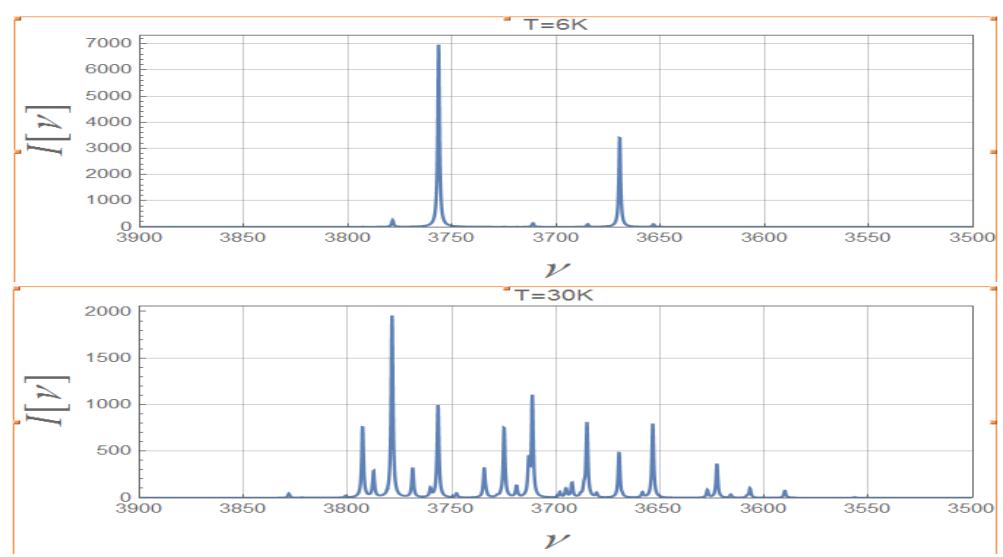
Comparing calculated IR spectra at 6 and 30 K one can see huge changes due to temperature rising. At 6 K trasitions from $(000, 0_{00})$ level are dominated. At 30 K intensities of these transitions become smaller and intensities of other trasitions become higher. These changes are due to increasing of the population of the exited rotational levels of the ground vibrational state. Calculated and experimental [2,3] intensities of rovibrational bands are compared and some conclusions about lifetime of the exited states and relaxations times of the ortho-para transitions in Ar matrix were made.