Three-dimensional (3D) laser micro/nano-structuring (LMNS) of polymers has improved dramatically in recent years. However, there is still very little concrete information in regards to the underlying processes. The two most plausible mechanisms for LMNS are as follows: purely chemical reactions based on two-photon absorption (2PA) where photoinitiator molecules are excited via 2PA and subsequently form radicals that initiate a polymerization reaction. This leads to the solidification of the photoresist [1]. The other plausible mechanism is a photo-thermal one where the rapid localized temperature changes initiate the polymerization reaction caused by laser irradiation.
For better understanding of the occurring processes one needs to be able to measure the local temperature changes in the photoresist during LMNS. In order to do that a suitable method must be applied. This work is dedicated to studying the suitability of bovine serum albumin stabilized gold nanoclusters (BSA-Au NCs) as photoluminescent temperature detectors dispersed in the photoresist solution. The photoresist we have chosen in this case was polyethylene glycol diacrylate (PEG-DA).
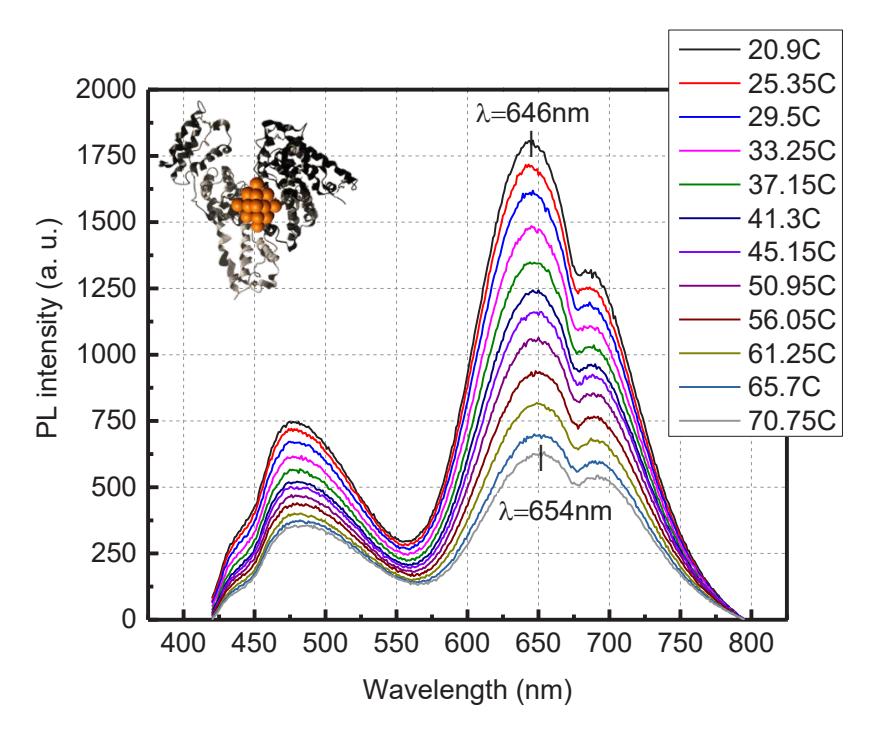
BSA-Au NCs were synthesized according to the modified Xie protocol [2]. The photoluminescence spectrum of BSA-Au NCs in aqueous solutions is dependent on temperature. By using spectroscopic methods we studied whether BSA-Au NCs retain these properties when dispersed in PEG-DA solution. The following results were obtained: the increase of the solution temperature caused the decrease of BSA-Au NC photoluminescence intensity and a bathochromic shift of the photoluminescence band (Fig. 1). The spectral changes in the PEG-DA solution are analogous to those in aqueous solutions. Therefore, BSA-Au NCs should be suitable for local temperature change monitoring in PEG-DA solutions during LMNS if no additional processes occur that cause the degradation of BSA-Au NCs.