
Electron microscopy is one of the most rapidly advancing types of high-resolution microscopy, which has reached a resolving power close to 0.5 Å. Of particular interest now are scanning transmission electron microscopes (STEMs), that currently form the highest-available resolution images point by point. One of the main advantages of such microscope is the ability to acquire several different signals at the same time. Because of the high resolution achieved and an extremely small area of excitation (compared to optical microscopes), together with a light collection system they can be used to identify and monitor the emission of individual nano-sized emitters, for example, quantum wells. [1] However, even with a precisely controlled excitation area, one cannot guarantee that nearby structures will not be excited due to plasmon or electron-hole pair diffusion.
One paramater of particular interest to monitor is the electron-hole recombination lifetimes. It provides an insight to quantum-confined Stark effect (QCSE) that is often present in III-Nitride emitters due to internal electric field existing in structures made from these materials. Since electron-hole recombination lifetimes depend on the electron-hole wave function overlap, changes to the band structure induced by the mentioned effect can drastically increase this lifetime (by decreasing the overlap). [2]
In this study we present electron microscopy-based cathodoluminescence (CL) on AlN/GaN nanowires with quantum disks (QDisks). We show that by increasing the charge density in the QDisk (effectively screening the internal electric field), we can in turn reduce the QCSE, and observe a shift that is more evident in thick QDisks because the electrone-hole wavefunction overlap is smaller. Thus, the monitoring of lifetimes can give interesting insight to QCSE inside the confined GaN layer. We report the coupling of a CL system to an upgraded Hanbury-Brown Triss (HBT) interferometer (with an added spectrometer acting as a computer-controlled monochromator) shown in Figure 1. The setup was used for measuring the lifetimes of carriers in QDisks with non-larger than 15 nm separations. The lifetimes are extracted by observing a photon bunching effect, present in the QDisk emission. [3, 4]
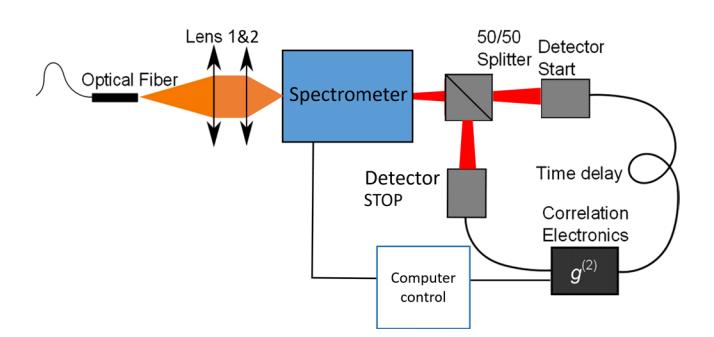
The study is a continuation of prolonged measurements [1, 2, 3, 4] to fully model the QCSE in single emitters and possibly measure the internal electric field. It proves the model of carrier wave function separation and the compensation of it by a shielding effect, more evident in thick QDisks. The upgraded HBT interferometer provides further insight to QCSE and helps not only to establish a strong theory on the subject, but also to better understand and tackle this, usually, unwanted effect.