
Three dimensional shaping of focused laser beam is of great importance in many modern laser fields. Long focal lines with transverse spot sizes as small as a few wavelengths are called optical needles [1]. Polarization control of the electric field in the optical needle is the next step towards engineering of focal lines suitable for applications, where the orientation of electromagnetic field is important. Optical needles with almost pure longitudinal polarization have a potential application in direct acceleration of charged particles [2].
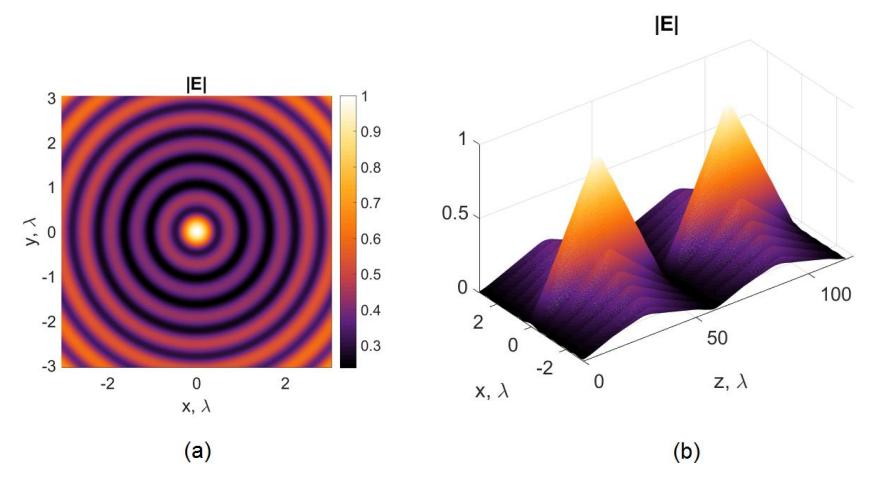
In this work we consider the formation of optical needle by superposition of monochromatic vector Bessel beams. The longitudinal profile of intensity is fully controlled, while transverse – partly. Vector beams were obtained from scalar Bessel beams using method described in [3]. Firstly, we analyse how combination of topological number m and polarization of Bessel beams controls an on-axis orientation and localization of electric field. We demonstrate a successfully achieved control of intensity pattern for three different polarizations: two transverse and one longitudinal. Focal lines, created by superposition of linearly, radially or circularly polarized vector Bessel beams with m=0, have central spots (full width at half maximum) smaller than a wavelength of the beam at certain Bessel cone angles. Furthermore, we get that linear superposition of circularly and radially polarized vector Bessel beams with different topological numbers form focus with almost pure transverse polarization. An example of superposition of twenty radially polarized Bessel beams with m=0, having predefined longitudinal profile of intensity, is shown in Fig. 1.
In conclusion, a method of optical engineering of focal lines will be presented. Examples of calculated intensity profiles with linear focus will be demonstrated. Experimental implementation using spatial light modulators or alternative techniques will be also discussed.