
The synthesis of new magnetic materials, the study of the crystal structure features and the establishment of the their relationship with the physical and chemical properties in a wide temperature range are the priority tendency of condensed matter physics because of the advantage over their use in the development of multi-functional instrumental matrix for solid-state electronics.
For fundamental research and application purpose the apparent interest introduce MnSe magnetic semiconductors and based on them solid solutions with cationic substitution of manganese by rare earth element – gadolinium [1].
The samples of $Mn_{1-x}Gd_xSe$ ($0 \le x \le 1,0$) system were obtained by a solid phase reaction method from initial chemical elements powders. X-ray diffraction analysis was carried out by "DRON-2" apparatus in the Cu-K$\alpha$ -radiation. For example, on Fig. 1 is shown the X-Ray pattern of the $Mn_{0,95}Gd_{0,05}Se$ sample.
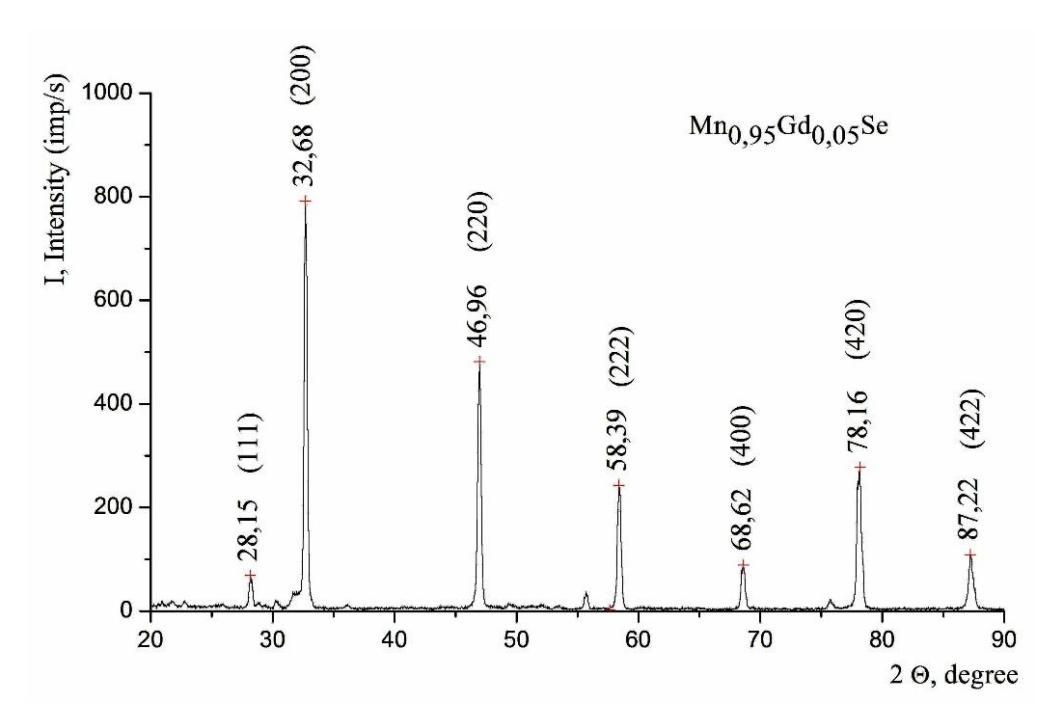
All synthesized samples of the $Mn_{1-x}Gd_xSe$ systems have a NaCl type cubic lattice of the Fm3m space group. The unit cell parameter linearly increases with gadolinium content increasing in solid solutions: from 0.5468 nm (MnSe) to 0.5769 nm (Mn0.1Gd0.9Se).