
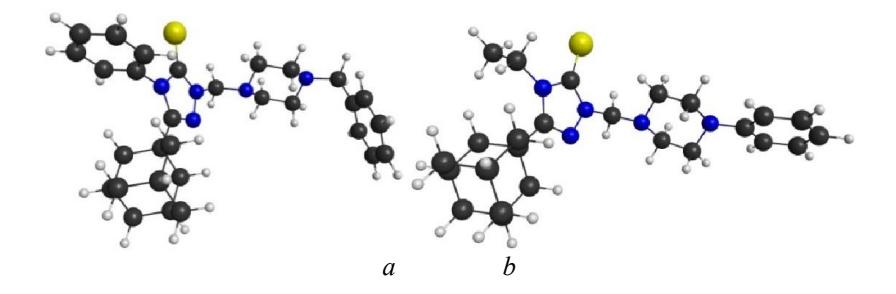
The adamantine (C10H16) containing compounds have a number of useful properties: a high degree of lipophilicity, highly reactive, etc. In this regard, the adamantane derivatives represent a class of organic compounds finding extensive medical applications owing to their ability to therapeutic activity. It is found that the presence in the structure of compound adamantyl group almost always increases the degree of its biological activity. Thus, the high lipophilicity of an adamantyl fragment provides a slight penetration of the drug through the blood-brain barrier. Adamantane derivatives may act as potential agents for the treatment of neurological diseases, malaria, inflammatory diseases, tuberculosis, and cancer. Currently, at least seven drugs on the basis of adamantane-containing compounds have clinical use and several dozen clinical trials.In this work the structural and spectral characteristics of adamantane derivatives (3-(adamantan-1-yl)-1-[(4-benzylpiperazin-1-yl)methyl]-4-phenyl-1H-1,2,4-triazole-5(4H)-thione, C30H37N5S, or compound I, and 3-(adamantan-1-yl)-4-ethyl-1-[(4-phenylpiperazin-1-yl)methyl]-1H-1,2,4-triazole-5(4H)-thione, C25H35N5S, or compound II) (see Fig. 1) were studied. In continuation to our interest in the pharmacological and structural properties of the adamantane derivatives, the results of the present study will help to achieve a better understanding of the properties of such derivatives.
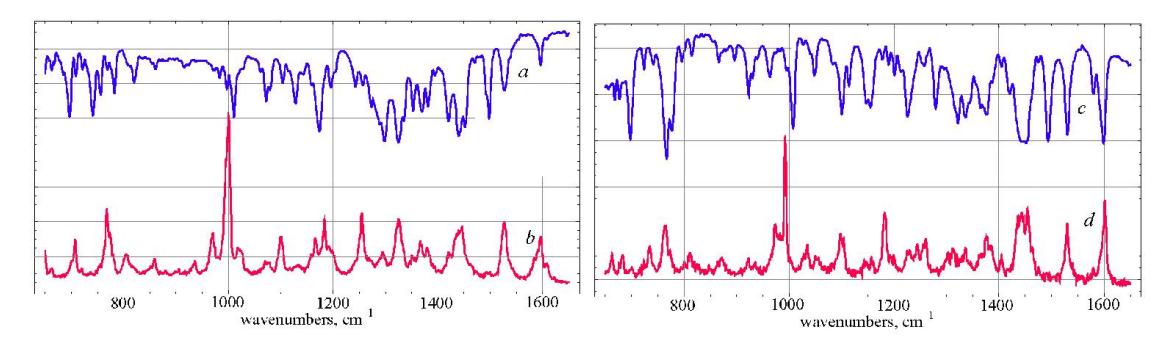
The FTIR spectra (Fig. 2, a, c) have been measured in reflection mode in the range of 3200–650 cm-1. Raman scattering spectra in the range of 3200–150 cm-1 (Fig. 2, b, d) have been measured using a second harmonic (532 nm) of the Nd:YAG laser. The electronic absorption (UV/Vis) spectra of the solutions of the compounds in ethanol have been measured in the range of 450–200 nm. Calculations of the structural and spectral vibrational characteristics of the molecules were performed using the standard cc-pVDZ basis by DFT methods with the help of the hybrid B3LYP functional. Calculations of the UV/Vis spectra were performed in the TDDFT and MRPT (Multi Reference Perturbation Theory) approximations. On the basis of the calculations the complete interpretation of the spectra was obtained. The biological activity indices Pa (probability to be active) have been predicted. The predicted Pa indices have high values. For example, the Pa value for analgesic activity for the compound I is 0.816.
The comprehensive experimental and theoretical studies of the optical properties of some adamantane-containing compounds carried out, and it may be useful in medicinal chemistry and for the drugs design.