
There are many systems and processes where the time dependence of the central second moment is not linear as in the classical Brownian motion. Such family of processes is called anomalous diffusion [1]. Recently [2] it was suggested that the anomalous diffusion can be a result of heterogeneous diffusion process, where the diffusion coefficient depends on the position. The heterogeneous diffusion processes can yield subdiffusion as well as superdiffusion, depending on the behavior of the diffusion coefficient. Spatially dependent diffusion can occur in heterogeneous systems. For example, heterogeneous medium with steep gradients of the diffusivity can be created in thermophoresis experiments using a local variation of the temperature [3]. Here we consider heterogeneous diffusion processes with the power-law dependence of the diffusion coefficient on the position and investigate the influence of external forces on the resulting anomalous diffusion. We assume that not only the diffusion coefficient but also the external force has a power-law dependence on the position [4].
$$dx = \sigma^2 \left( \eta - \frac{\nu}{2} \right) x^{2\eta - 1} dt + \sigma x^{\eta} dW_t.\tag{1}$$Here $\eta$ is the power-law exponent of multiplicative noise, $\sigma$ is the amplitude of noise and $W_t$ is a standard Wiener process (Brownian motion). This stochastic differential equation is interpreted in Itô sense. Here $\nu$ is a new parameter describing the additional drift term. The meaning of the parameter $\nu$ is as follows: when the reflective boundaries at small positive $x = x_{\min}$ and large $x = x_{\max}$ are present, the steady-state PDF is a power-law function of position with the power-law exponent $\nu$, $P_0(x) \sim x^{-\nu}$.
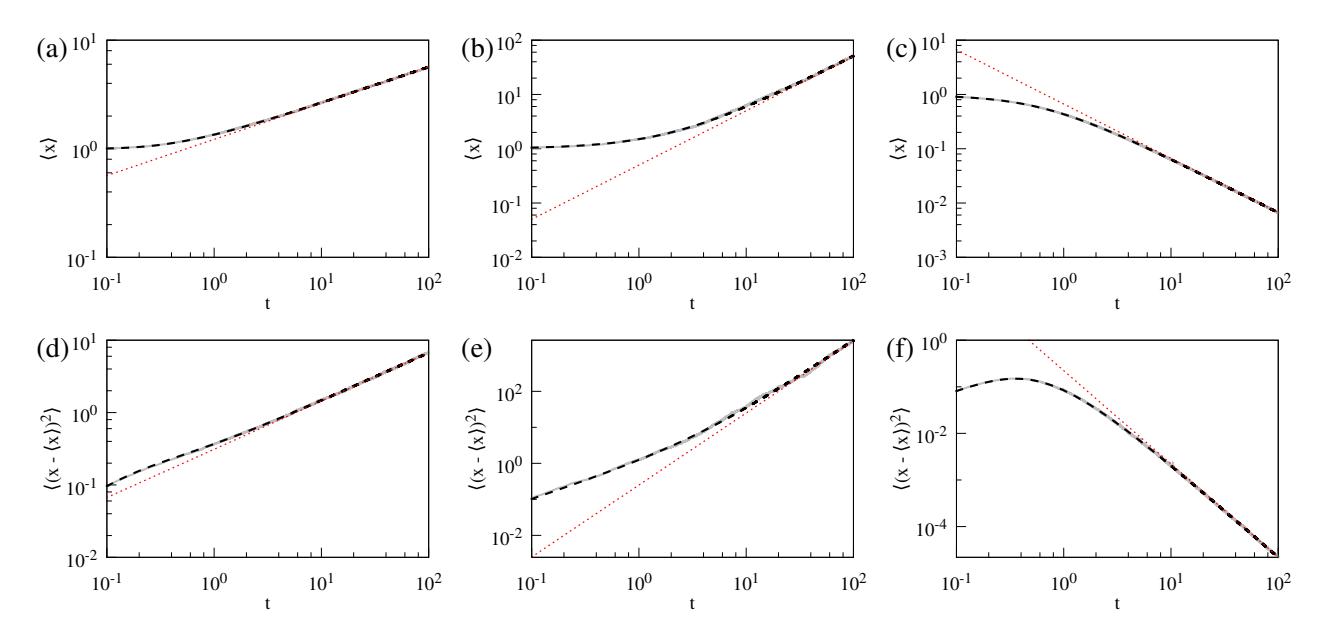
We found that the power-law exponent in the dependence of the mean square displacement on time does not depend on the external force; this force changes only the anomalous diffusion coefficient (see Fig. 1 (d) and (e)). Anomalous diffusion occur only for specific parameters values if $\nu < 3$ and $\eta < 1$ (or $\nu < 1$ and $\eta < 1$ ). As we can see in Fig. 1 (c) and (f), in other cases anomalous diffusion do not occur due localization of particles. Also, we obtain analytic expressions for the transition probability in two cases: when the power-law exponent in the external force is equal to $2\eta - 1$, where $2\eta$ is the power-law exponent in the dependence of the diffusion coefficient on the position, and when the external force has a linear dependence on the position.