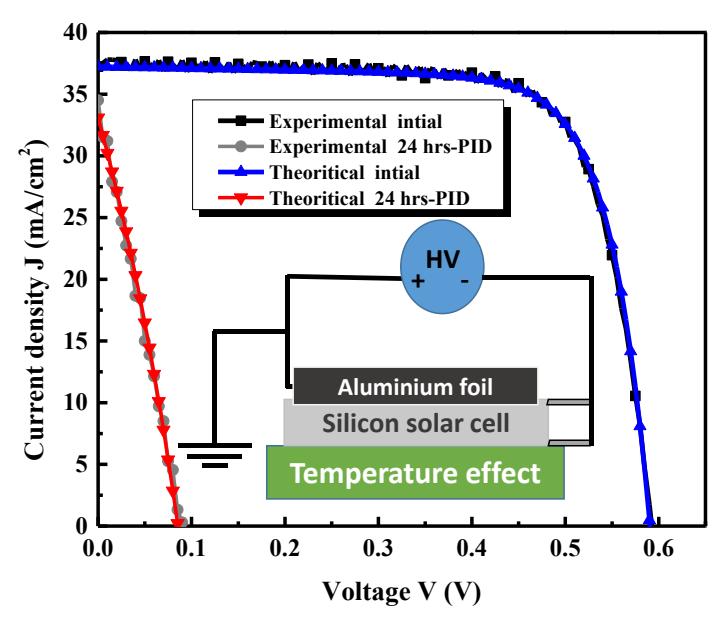
Potential-induced degradation (PID) is the most rapid degradation phenomena that leads to enormous declined of power output over the time in solar PV power plants. Most of the solar PV power plants installed worldwide consisting crystalline silicon (c-Si) PV panels in a string of an array. The potential difference between PV cell matrix and grounded aluminum frame leads to the movement of charge species through the available leakage path, majorly influences the occurrence of PID phenomena [1-5]. The c-Si solar cell has been performed under high voltage stress condition (-800 V) for 24 hours to understand the PID behavior at the cell level. The electrical performance parameters of c-Si solar cell such as short-circuit current density ($J_{SC}$), open-circuit voltage ($V_{OC}$), fill factor (FF) and the efficiency ($\eta$) drastically decrease under PID effect. The values of FF and $\eta$ have been reduced from 0.74 to 0.24 and 16.5% to 0.83%, respectively. The decrease in the shunt resistance value $R_{SH}$ is mainly affected due to the diffusion of Na+ in the P-N junction. The two-diode model has been proposed to further investigate the recombination effect under PID mechanism at cell level. The leakage current increases drastically as the voltage stress increases from 0 to 800 V. The results thus gives an indication that the P-N junction diode and the recombination within the space-charge region are mainly affected under high voltage stress condition.