
Wheel-rail problem is studied in this work. Two formulations of the problem are considered: classical "tribological", in which wheel interacts with the short segment of the rigidly fixed rail and new “tribo-fatigue”, which studies multibody system, containing of some wheels and long rail. Tribo-fatigue approach takes into account both contact interaction of system elements and bending of the rail lying on an elastic Winkler's foundation by a train [1]. Both methods are verified with the help of the analytical solutions, based on the well-known strength of materials and Hertz's contact theories. Another very important purpose of this work was to show that new material Monica (VCHTG high strength cast iron) [2] is more preferred material for rails, than steel.
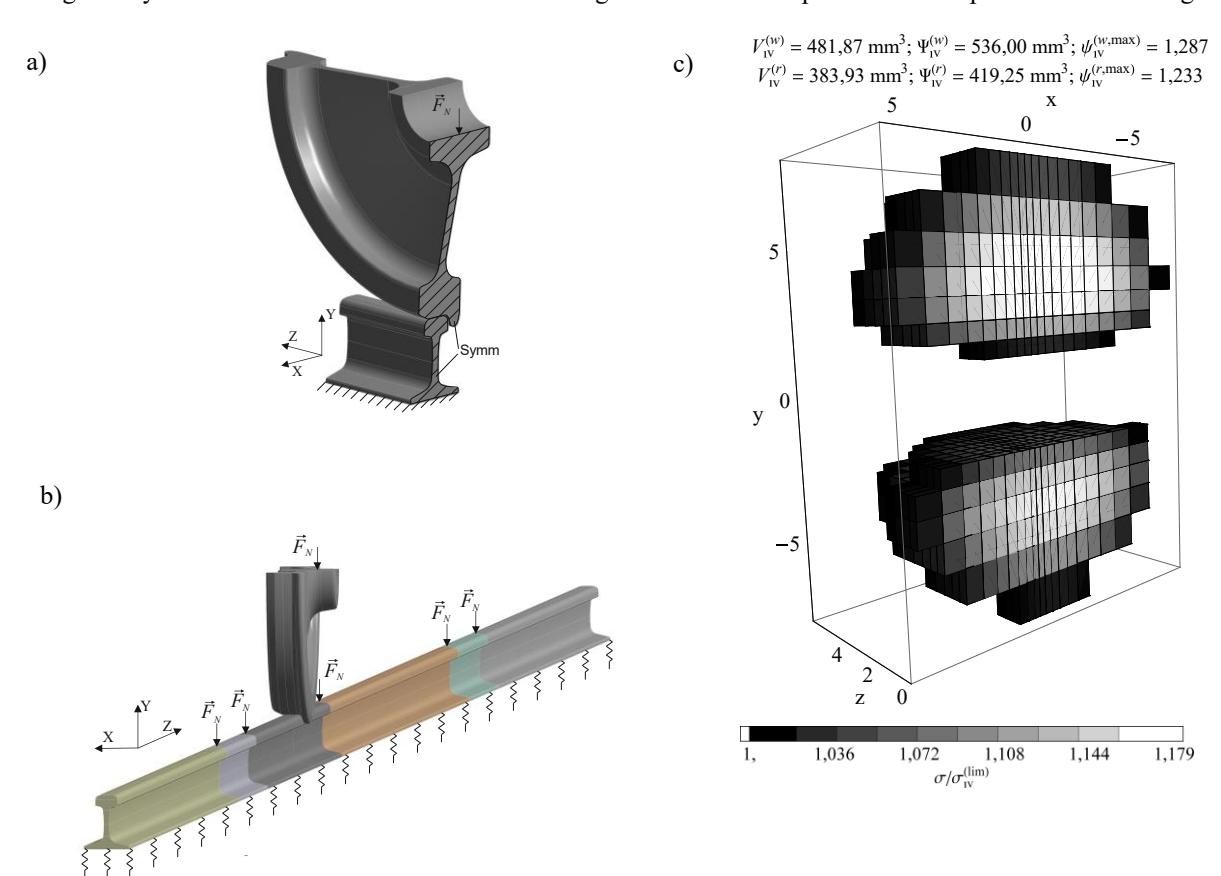
Mechanical and mathematical models are constructed (see Fig. 1a, 1b) for elastic static statement. Computer finite element modeling is carried out for determination of wheel/rail system spatial stress-strain state and dangerous volumes [3] (see Fig. 1c) as an integral indicators of damageability taking into account contact interaction between the wheel and the rail, bending of the rail on elastic foundation by the adjacent wheels (whole train). Significant increase of volumetric damageability of about 1.5 times is shown for tribo-fatigue formulation of problem in comparison with tribological.
Using new structural material Monica which has high strength, rolling fatigue limits and ductility decreases volumetric damageability of the system elements by about 47%. It determines the feasibility of railway rails production of Monica.