
Light emitting diodes employing heavy-metal complexes are very attractive since the electroluminescence (EL) efficiency, which is limited by the radiative recombination of singlet excitons and can be increased by the addition of the phosphorescent emission from the triplet excitons of the complexes. In order to obtain efficient emission from the complexes, they are usually dispersed in a suitable host displaying the two main properties of: 1) providing efficient energy/charge transfer to the phosphorescent dopants and 2) avoiding concentration quenching effects of the complexes. The use of an electroluminescent polymer as host for the phosphorescent complexes has the further advantage that its own fluorescent component can be exploited for multicolor emission, provided that the energy transfer (ET) from polymer to phosphorescent guest is incomplete and that no direct charge trapping at the dopant site occurs. Thanks to their narrow red emission, Eu3+-complexes have attracted considerable interest in designing organic light emitting diodes (OLEDs) for full color displays. In the last few years, many reports appeared where blends of Eu3+-diketonates in fluorescent π-conjugated polymers polyfluorenes type have been used. Förster resonant energy transfer (FRET) takes place in such blends because of overlap between the polymer emission and complex absorption.
In this paper, we report on a simple and promising approach to realize EL heterostructures using a blend film of blue and red-orange Eu3+ complex. Bright blue emission in the 410-450 nm range is characteristic of the PFD (poly(9,9-di-n-dodecylfluorenyl-2,7-diyl). The overlapping absorption was shown for EuWi3·2KM complex (where Wi – carbacylamidophosphate ligand PhC(O)NP(O)(OCH3)2; KM - Michler's ketone [(CH3)2NC6H4]2CO) in the range 390-440 nm. Also EuWi3Phen (Phen = 1,10 – phenantroline) complex with absorption in the range 275-350 nm was used. Both complexes under investigation, being excited by UV light, show intensive photoluminescence with maxima at 612.5 nm, observed for 5D0 – 7F2 transition.
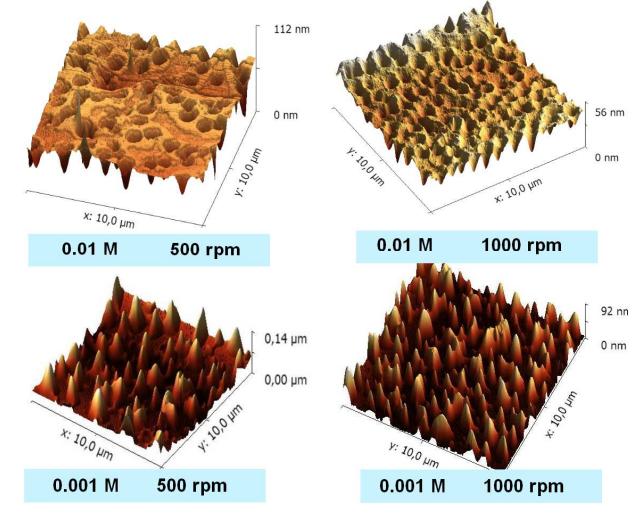
The strong correlation between frequency of the spin coating process and film thickness is confirmed by AFM images of EuWi3Phen films deposited at different resolutions (frequencies of rotation) and concentrations, as shown in Fig. 1. Absolute measurement of the film thickness was made. It can be easily observed that the homogeneity of the film is enhanced when the frequency of the spin coating process rises (Table 1).
| Deposition parameters | ||
|---|---|---|
| C, mol/l | Freqquency of rotation, rpm | Thickness, nm |
| 0,01 | 500 | 47 |
| 0,001 | 1000 | 10 |
| 0,01 | 500 | 4,5 |
| 0,001 | 1000 | 10 |
The polymer-based planar light-emitting heterostructures fabricated in this work have the ITO/PEDOT:PSS/PFD/Ca+Al (1) structure. Samples of different solution concentration have been created by spin coating and their current-voltage (A-V) characteristics have been investigated. The best A-V values of EL starting and puncture voltage were demonstrated for 5 mg/ml PFD solution. Wherefore this concentration was used for fabrication of polymer-blend-based EL devices. They have the structures ITO/PEDOT:PSS/PFD+EuWi3·2KM/Al+Ca (2) and ITO/PEDOT:PSS/PFD+EuWi3Phen/Al+Ca (3). Diodes prepared with thinner organic films allow higher currents at lower voltages; this can be achieved either by increasing the frequency of the spin coater rotation or by using concentrations of Complex:Toluene lower than 10% weight (the best values was demonstrated for 5%). Fig. 2 shows the I-V characteristics of 1-3 heterostructures. The PFD and PFD-Complex layers were deposited at the same spin coater frequencies of rotation (2500 rpm). Bright electroluminescence in all heterostructures was observed. In general, the best performance of the devices made with europium complexes was observed.