
Photochromic compounds, such as 3H-naphthopyrans, have been applied in commercially available photochromic lenses, for which one of the serious issue is a residual color. 3H-naphthopyrans generate the transoid-cis (TC) form and the transoid-trans (TT) form by UV light irradiation. Typically thermal back reaction of TC form takes from several seconds to tens of seconds while TT form needs much more time. Recently, the suppression of the generation of the TT form was achieved simply by substituting a bulky substituent to the 2-position of the naphthopyrans [1]. However, there are still open questions whether the bulky substituent may also interfere the ring-opening reaction and, as a result, decrease the photochromic reaction efficiency. On the other hand it is important to answer the question whether the TT form is completely suppressed or the lifetime of the TT form is accelerated faster than microseconds.
Herein, naphthopyrans with various aryl substituents (phenyl, naphthalenyl and pyrenyl, Fig. 1) at the 2-position were studied. Time-resolved UV-vis and mid-IR optical spectroscopies were applied to detect the transient species involved in the photoreaction over time-scale from subpicosecond to hundreds of microseconds. The early steps of the photoreaction through detection of C=O group (absorption band at $\approx 1650 \text{ cm}^{-1}$) as a result of the photoinduced ring-opening reaction were revealed by mid-IR ultrafast spectroscopy. Femtosecond UV-vis transient absorption data show an initial broad spectrum corresponding to the S1 excited state of the closed-ring. At delays of few nanoseconds absorption band of TC form can be clearly observed (Fig 1).
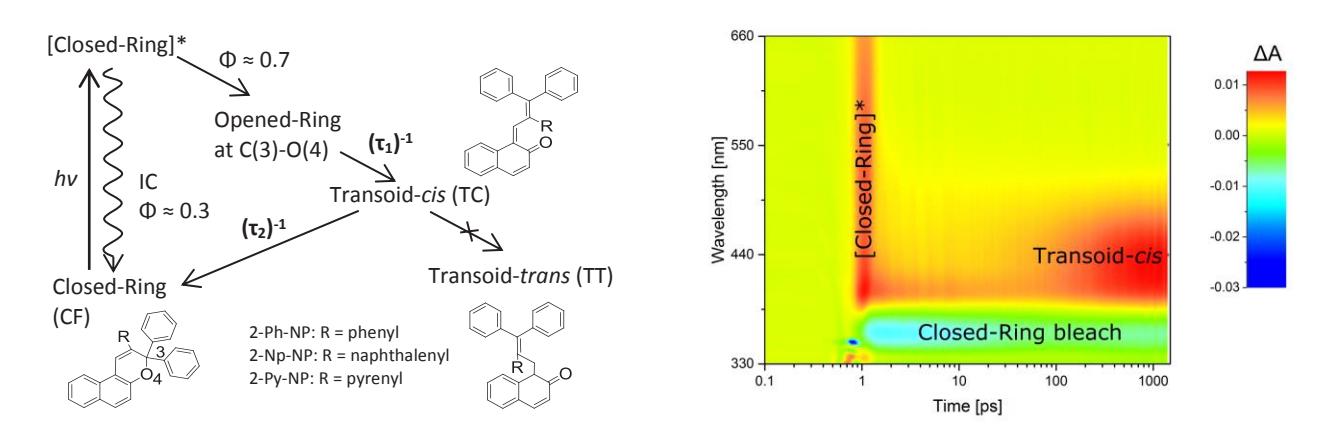
On the basis of time-resolved data a following reaction mechanism emerges (Figure 1). At the beginning, closed-form (CF) absorbs the UV photon, which brings the molecule to the singlet excited state. The S1 excited state lifetime $\tau_{\text{S1}}$ is very short ($\approx 0.3$ ps). In the next, the S1$\rightarrow$S0 internal conversion repopulates back the initial CF (with yield $\Phi \approx 0.3$) or C(sp3)-O bond cleavage occurs (with yield $\approx 0.7$). The nascent opened-ring form structurally relaxes to the transoid-cis (TC) form with a rate of $(260 \text{ ps})^{-1}$, $(400 \text{ ps})^{-1}$ and $(950 \text{ ps})^{-1}$ for phenyl, naphthalenyl and pyrenyl derivative, respectively, in acetonitrile. Over microsecond time-scale TC$\rightarrow$TT reaction path is suppressed by the efficient TC$\rightarrow$CF ring-closure reaction with color-fading rate equal to (tens of $\mu$s)-1. The substituent R (Fig. 1) exerts a great impact on the rates of TC formation and the subsequent decay TC$\rightarrow$CF. Important role is played by steric and electrostatic repulsions between the aryl substituent group and C=O group. Moreover, solvent viscosity and polarity affect the kinetics: a viscous solvent decelerates TC formation, while the opposite effect is caused by high solvent polarity. A polar solvent stabilizes the polar TC species and decelerates the subsequent TC$\rightarrow$CF reaction.
In summary, the photocycle is free from TT isomer and fast TC$\rightarrow$CF back-reaction takes place. These findings are not only important for fundamental photochemistry but also demonstrate the potential of these molecular designs for developing optimal photofunctional materials.