
Nowadays there is a high demand for energy efficient, high-power and high quality white light sources. The most promising device that satisfies all these requirements is the light-emitting diode (LED). However, several advances in LED technology still have to be made in order for them to be more widely used as light sources in household lighting. Currently blue-light LEDs and downconverting YAG:Ce phosphors encapsulated in silicon is the most commonly used method for producing white light. This approach suffers from a high thermal degradation rate and poor color rendering. Fortunately, color rendering properties can be improved by modifying the composition of the YAG host, while thermal degradation can be decreased by using glass ceramics.
We investigated heat-treated glass ceramics with composition Y2CaAlGe(AlO4)3:Ce. After glass ceramics production two samples were further treated at 1300 °C and 1400 °C for 1 hour. An untreated sample was also investigated as a reference. The samples were produced in Belarusian State Technical University, Belarus.
The light-emitting properties of samples under study were investigated by measuring their photoluminescence (PL) spectra. The measurements were performed with a microscope system WITech Alpha 300 S in confocal mode. PL emission spectra was recorded using a spectrometer with a thermoelectrically cooled CCD camera. PL excitation was performed with a CW laser diode emitting at 405 nm (ALPHALAS) as well as a He-Cd laser emitting at 442 nm. Also photoluminescence at different excitation power densities was investigated. All measurements were performed at room temperature.
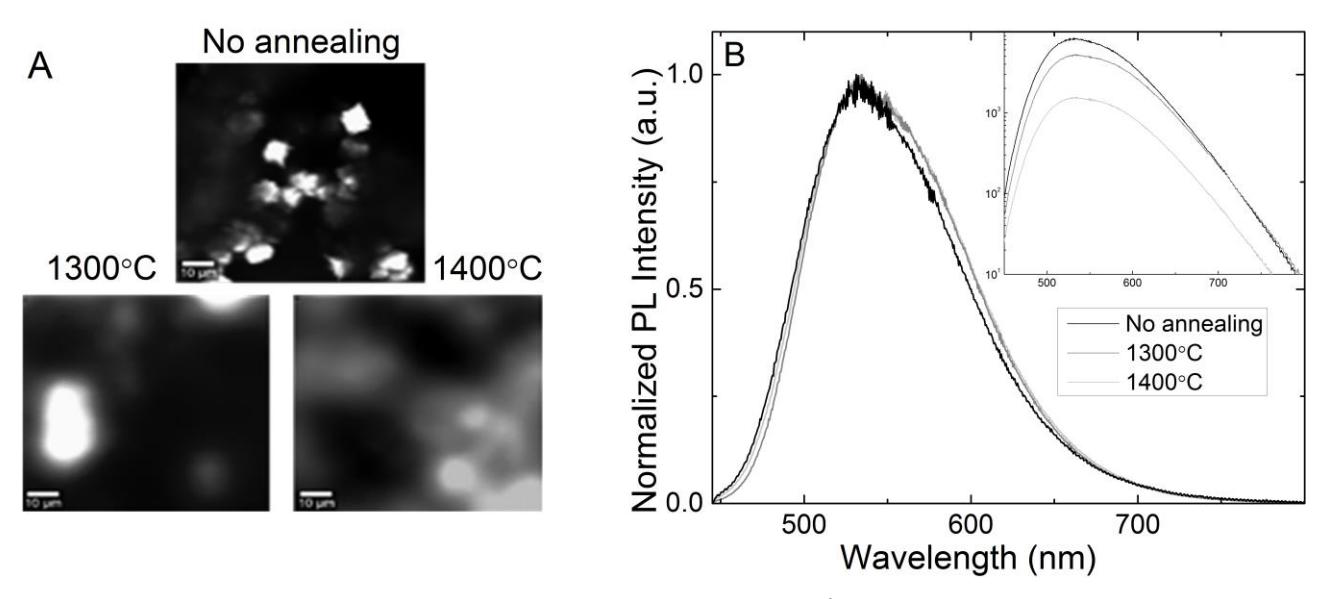
In the unannealed sample well defined, crystallite-like, structured areas are visible in the spectrally integrated PL Intensity distribution (Fig. 1 A). In comparison with other heat treated samples where there are no such defined areas. In the annealed samples only undefined, amorphous structures are visible. Comparison of spatially averaged spectra (Fig. 1 B) shows that average PL intensity of the annealed samples is lower than that of the unannealed sample. Additionally the FWHM of the PL spectra of annealed samples is larger, due to the longwave edge of the spectra being redshifted. The measurements performed with different excitation sources (405 nm and 442 nm) show that the spatial distributions of PL parameters are quite similar under different excitations. However, for the unannealed sample the bright PL areas are redshifted in comparison to the surrounding area when under 405 nm excitation. Under 442 nm excitation the bright areas are blueshifted relative to their surrounding area. Measurements over a wide range of excitation power densities reveal that the PL spectral shape is independent of excitation power and PL intensity increases linearly with increasing excitation density.
This widening and redshifting of the PL spectra is advantageous for producing warmer light sources, with better color rendering properties. As a result, the YCAGG:Ce ceramics are a promising candidate phosphor for white LEDs.