In fuel cells, formation of pH gradients at electrodes is a major issue since it may lead to ohmic losses, but it was never measured locally. The availability of data on pH changes in the surroundings of the electrodical surface could create a deeper understanding of the catalytic processes that occur in fuel cells and in other applications where pH plays an important role in determining process performance, such as CO2 reduction, for example.
In this work we present local pH measurement via open circuit potential (OCP) measurements on a microstructured Pt/Au electrode: this substrate is used to generate H2 or O2 via electrolysis and the local consumption of H+ or OH- ions is detected by the device described below as a difference in OCP. The results shown are currently setting the foundations for further studies on photocatalysts' activity towards watersplitting reactions.
Scanning ion conductance microscopy (SICM) is an imaging technique useful for pH mapping (thus revealing the preferential sites of the watersplitting reactions): the integration of this technique with a three-electrode electrochemical system provides simultaneous information on the topographical imaging of a nanostructured sample and on the electrochemical and catalytic activity of the sample itself. This integration is provided by coating the borosilicate micropipette with a 150 nm-thick Pt layer (deposited via MOCVD) that acts as a WE.
In order to achieve maximum resolution for the simultaneous topography and electrochemical measurements just a small area of the coated surface is in contact with the electrolyte: a fully insulating coating was studied, created and tested via cyclic voltammetry (CV), using an industrial spray paint. The thickness of the coating is estimated to be 500 μm. The tip was opened putting it in contact with a small quantity of xylene and the pipettes were then characterized with CVs in Ru(NH3)6Cl3.
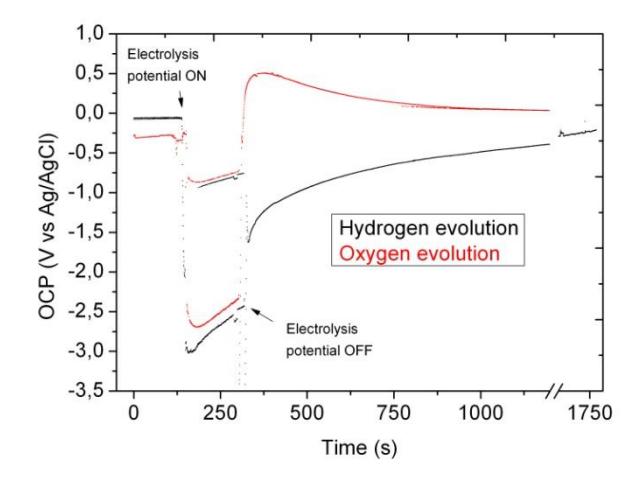
Before use, each pipette is calibrated performing OCP measurements in solutions with different pH, ranging from 1 to 12. Finally, a microstructured Pt/Au electrodes array was prepared via lithographic technique and the electrochemical process was studied, with the integrated device described above, at a fixed distance of 100 μm from the electrodical surface: resulting curves OCP vs time show clearly the different trend of OCP before, during and after gas generation, due to a different pH of the surrounding environment (Fig. 1). Several experiments were carried with H2 and O2 evolution, in various aqueous media and at different buffered pH.